>
 TaxCalc.pk
FY 2026-27
TaxCalc.pk
FY 2026-27
Understand the key differences between trademarks, copyrights, and patents in Pakistan. Learn IPO-Pakistan filing fees, protection terms, and laws.
By Syed Asad Hussain Zaidi · 8 September 2026
Author Note / Last Updated: Updated September 2026 by Syed Asad Hussain Zaidi | Advocate High Court | Professional Tax Consultant
"I need to patent my brand name," or "I want to copyright my new mechanical invention."
In corporate law offices and chambers across Karachi, Lahore, and Islamabad, these phrases are heard almost every day. They reflect a widespread and expensive misunderstanding among Pakistani business owners, startup founders, and creative professionals.
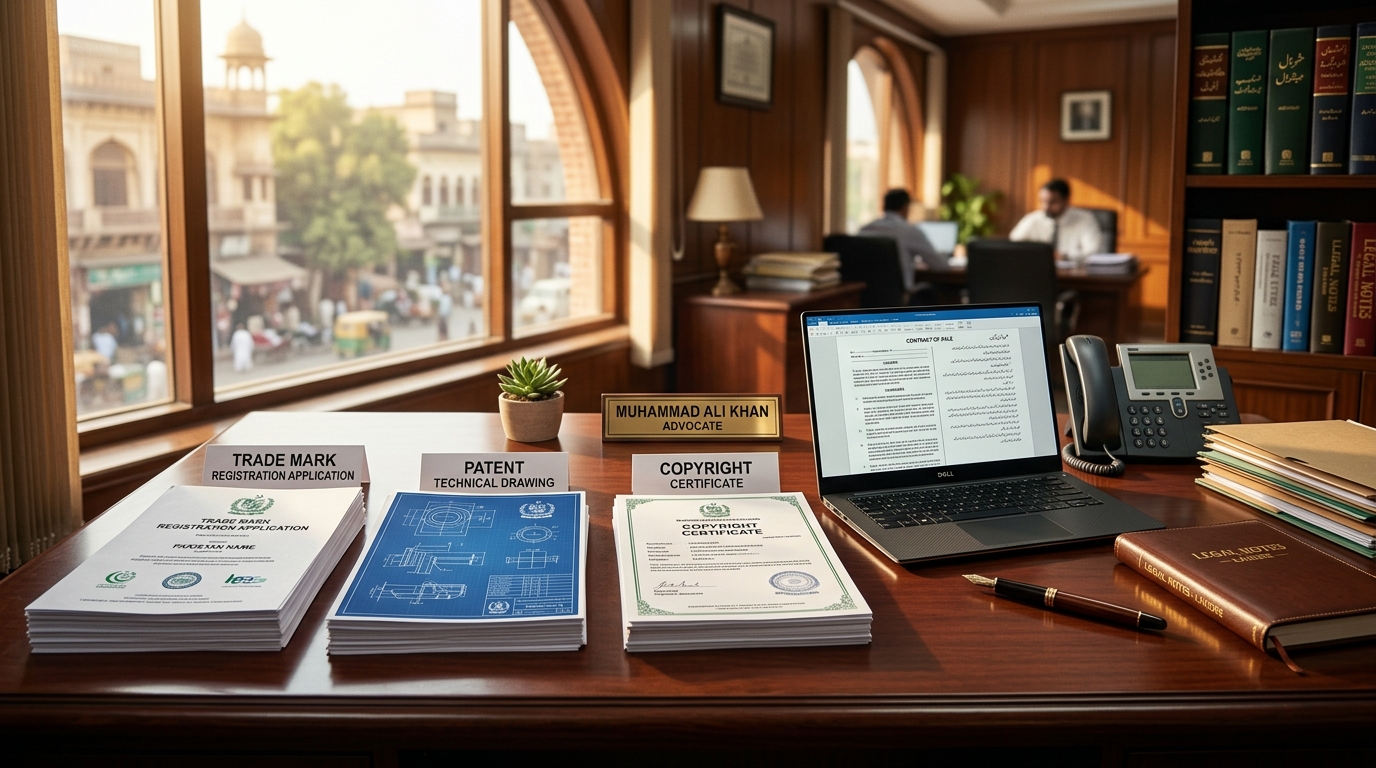
Intellectual Property (IP) is not a single, one-size-fits-all legal shield. It is a structured legal framework administered by the Intellectual Property Organization of Pakistan (IPO-Pakistan) through distinct statutory offices. There are three primary pillars of intellectual property: Trademarks, Copyrights, and Patents. Each pillar is governed by its own Act of Parliament, protects an entirely different type of intangible asset, follows its own application procedure, and carries distinct expiry rules.
Filing the wrong application does more than waste government fees—it leaves your most valuable commercial assets completely exposed to counterfeiters, competitors, and bad-faith registrants.
This comprehensive guide clarifies the exact statutory differences between trademarks, copyrights, and patents in Pakistan, illustrates how modern businesses utilize all three simultaneously, and provides a strategic decision framework for protecting your enterprise.
| Feature | Trademark | Copyright | Patent | | :--- | :--- | :--- | :--- | | Governing Statute | Trade Marks Ordinance, 2001 | Copyright Ordinance, 1962 | Patents Ordinance, 2000 | | Primary Registry | Trade Marks Registry (TMR) | Copyright Office | The Patent Office | | What It Protects | Brand identity, logos, names, slogans, packaging shapes | Original creative expression, literary works, source code, art | Inventions, novel mechanisms, processes, formulations | | Core Requirement | Distinctiveness (not deceptively similar) | Originality (not copied from elsewhere) | Global Novelty, Inventive Step, Industrial Applicability | | Protection Duration | 10 Years (Renewable indefinitely) | Author’s Life + 50 Years (50 yrs for corporate/software) | Exactly 20 Years (Non-renewable) | | Registration Mandatory? | Recommended (unregistered marks rely on weak passing-off tort) | Automatic upon creation (registration provides prima facie proof) | Mandatory (no protection exists without an issued patent) | | Public Domain Expiry? | Never (as long as renewed every 10 years) | Enters public domain after 50-year post-mortem term | Enters public domain immediately after 20 years |
A trademark is a recognizable sign, design, or expression that identifies products or services of a particular business and distinguishes them from competitors in the marketplace. Under the Trade Marks Ordinance, 2001, a trademark can comprise:
Trademarks are administered by the Trade Marks Registry (TMR) under IPO-Pakistan, with principal registries in Karachi and regional offices in Lahore and Islamabad.
A registered trademark in Pakistan is granted for an initial term of 10 years from the date of application. Unlike copyrights and patents, a trademark can last forever, provided the owner pays the statutory renewal fee under Form TM-12 every 10 years.
To secure trademark registration, your proposed mark must meet two critical criteria:
You need a trademark whenever you are building commercial goodwill. If you launch an e-commerce brand, open a restaurant in Gulberg, or export apparel, securing your trademark prevents competitors from copying your label or confusing consumers with similar-looking knockoffs.
Copyright protects original works of authorship fixed in a tangible medium of expression. Governed by the Copyright Ordinance, 1962, copyright law protects the specific expression of an idea, not the idea, concept, or functional system itself.
In Pakistan, protectable works include:
Copyright filings are handled by the Copyright Office of IPO-Pakistan (located in Karachi, with facilitation desks in Lahore and Islamabad).
The duration of copyright protection in Pakistan depends on the nature of the author:
Once this period lapses, the work enters the public domain, meaning anyone can reproduce or adapt it without paying royalties.
Under the Berne Convention and Pakistani law, copyright protection vests automatically the exact moment an original work is created and recorded in tangible form (such as saving code to a repository or writing a manuscript).
However, formal registration via Form-II with the Copyright Office is strongly advisable. A government-issued Copyright Registration Certificate serves as prima facie proof of ownership in Pakistani courts, making it vastly simpler to secure an interim injunction or initiate criminal proceedings through the Federal Investigation Agency (FIA) against copyright pirates.
A patent is an exclusive legal monopoly granted by the State to an inventor in exchange for full public disclosure of how the invention works. Governed by the Patents Ordinance, 2000, patents protect functional solutions, industrial mechanisms, chemical compositions, pharmaceutical compounds, and manufacturing processes.
Patents do not protect names, artistic appearances, or abstract mathematical concepts. They protect how an apparatus, machine, or technical process operates.
Patents are examined and granted by the Patent Office of IPO-Pakistan, located in Karachi.
In Pakistan, a patent is granted for a non-negotiable term of exactly 20 years from the official filing date. A patent can never be renewed beyond 20 years. Once the 20-year term expires, the patented technology permanently enters the public domain. This statutory expiration allows competing Pakistani manufacturers to produce generic versions (the primary mechanism behind affordable generic pharmaceuticals after original brand-name drug patents lapse).
Under Section 8 of the Patents Ordinance, 2000, an invention must satisfy three cumulative statutory requirements:
To understand how these three regimes interact, consider a Pakistani health-tech company that invents a smart portable ECG heart-monitoring device:
| IP Discipline | Governing Statute | Protected Asset in Smart Health Device | Statutory Protection Scope | | :--- | :--- | :--- | :--- | | Patent | Patents Ordinance, 2000 | Novel micro-sensor mechanism and signal processing hardware arrangement. | 20-year exclusive monopoly over technical invention and functional utility. | | Copyright | Copyright Ordinance, 1962 | Embedded firmware source code, mobile app codebase, and user instruction manual. | Life of author + 50 years protection against unauthorized copying and duplication. | | Trademark | Trade Marks Ordinance, 2001 | Brand name "CardioPulse" and distinctive heart-wave logo on product and packaging. | 10-year renewable protection against commercial confusion and counterfeit imitation. |
Registering a private limited company (e.g., "Apex Logistics Pvt Ltd") with the Securities and Exchange Commission of Pakistan (SECP) gives you corporate incorporation rights, but zero intellectual property protection. An entity with a registered trademark at IPO-Pakistan can legally force an SECP-registered company to alter its corporate name and cease operations if it infringes upon their registered mark.
Unlike trademarks (which can claim prior commercial use), patents strictly require global novelty. If you showcase your prototype at an IT exhibition in Karachi or post a technical demonstration on YouTube before filing your provisional application at the Patent Office, your own public disclosure destroys novelty, permanently forfeiting your right to a patent.
Under Pakistani copyright law, if you hire an independent freelance developer to build your website, ERP system, or mobile app without an explicit written Assignment of Intellectual Property Agreement, the independent contractor legally retains economic copyright ownership, even if you paid their invoices in full. Always ensure contracts specify that all IP is assigned irrevocably to your firm upon creation.
| Business Stage | Primary Asset | Priority Filing | Secondary Filing | | :--- | :--- | :--- | :--- | | Startup Pre-Launch | Brand Name, Product Title, Logo | Trademark (Form TM-1) to secure filing priority | Domain reservation (.pk / PKNIC) | | Tech / SaaS Firm | Proprietary Source Code, Database Architecture | Copyright (Form-II) with source code deposits | Trademark on Platform Name (Class 9 & 42) | | Engineering / Pharma | Novel Physical Apparatus, Chemical Synthesis | Patent (Form P-1 / P-2) prior to any public disclosure | Industrial Design (Form D-1) for casing aesthetics | | FMCG / Retail Brand | Product Packaging Shape, Unique Bottle Design | Industrial Design (Form D-1) + Trademark | Copyright on label artistic illustrations |
Navigating intellectual property in Pakistan requires aligning your commercial goals with the correct statutory registry. Filing a trademark will not protect your software algorithm; registering a copyright will not prevent someone from opening a store under your name; and neglecting a patent application prior to commercial launch destroys your monopoly rights permanently.
At TaxCalc.pk, our corporate legal advisory team helps Pakistani businesses structure comprehensive IP audits, conduct pre-filing clearance searches, and secure robust protection across the Trade Marks Registry, Patent Office, and Copyright Office.
Disclaimer: This publication is provided for legal educational purposes and does not constitute formal legal advice. Intellectual property disputes and filings involve strict statutory deadlines and technical parameters. Consult an Advocate High Court or registered patent/trademark attorney for specialized representation.
Legal & Statutory Notice: The information provided in this publication is for general educational, academic, and statutory informational purposes only under the relevant laws of Pakistan (including the Income Tax Ordinance, 2001, the Companies Act, 2017, and the Trade Marks Ordinance, 2001). This content does not constitute formal legal, financial, or tax advice. For specific assessments, consult a licensed Advocate or qualified tax professional.