>
 TaxCalc.pk
FY 2026-27
TaxCalc.pk
FY 2026-27
Master patent drafting in Pakistan. Learn independent and dependent claims, provisional vs complete specifications, drawing rules, and prosecution.
By Syed Asad Hussain Zaidi · 8 September 2026
Author Note / Last Updated: Updated September 2026 by Syed Asad Hussain Zaidi | Advocate High Court | Senior Patent & IP Prosecution Counsel.
A patent is not merely a technical diploma or an academic publication; it is an exclusive economic monopoly granted by the State, conferring upon the patentee the statutory right to exclude competitors from making, using, selling, or importing the claimed invention for a statutory term of twenty years. In Pakistani intellectual property jurisprudence, the strength, commercial defensibility, and litigation survival of a patent do not depend on the sheer brilliance of the underlying invention. They depend almost exclusively on the technical precision and legal drafting of the patent specification and claims.
Under the Patents Ordinance, 2000 (Ordinance LXI of 2000) and the Patents Rules, 2003, the Patent Office at IPO-Pakistan in Karachi enforces rigorous disclosure and drafting benchmarks. A poorly drafted claim set will either invite immediate refusal during examination under Section 21, succumb to pre-grant opposition under Section 23, or prove entirely unenforceable in the High Court during an infringement action.
This comprehensive treatise delivers a practitioner-grade guide to mastering patent drafting and claim construction in Pakistan—spanning provisional versus complete specifications, claim architecture, drawing protocols, and strategic prosecution tactics.
The statutory framework governing patent drafting is codified in Chapter III of the Patents Ordinance, 2000:
| Specification Category | Statutory Provision & Forms | Key Requirements & Scope | | :--- | :--- | :--- | | Provisional Specification | Section 12; Form 1 & Form 2 | Describes the nature of the invention; establishes a 12-month priority date; does not require formal claims. | | Complete Specification | Section 13; Form 2 & Form P-16 | Fully discloses the best mode of operation; mandatory claim set defining legal boundaries; formal technical drawings. |
Under Section 12(1) of the Patents Ordinance, 2000, an applicant may file an application accompanied by a Provisional Specification. The provisional specification:
STRICT STATUTORY DEADLINE: Under Section 13(1), if an application is accompanied by a provisional specification, a Complete Specification must be filed within twelve (12) months from the date of filing the application. Unlike trademark prosecution, this 12-month period is statutory and cannot be extended. If the complete specification is not filed within twelve months, the application is deemed abandoned.
Under Section 13 of the Patents Ordinance, 2000, every complete specification must:
If an applicant conceals the best mode (e.g., hiding optimal operating temperatures, chemical reagent ratios, or algorithm steps as "trade secrets" while seeking a patent), the patent becomes vulnerable to immediate revocation under Section 46 on the grounds of insufficient description.
A compliant complete specification submitted to the Patent Office of Pakistan follows a standardized technical layout:
| Section Name | Required Contents | Drafting Traps to Avoid | | :--- | :--- | :--- | | Title of Invention | Concise, technically specific description (max 15 words). | Avoid vague, marketing terms like "A Revolutionary Novel Engine". | | Field of Invention | Broad category and specific technical domain. | Do not draft too narrowly; avoid restricting future applications. | | Prior Art Background | Analysis of existing patents and scientific literature. | Do not over-praise prior art or concede that prior art solved the problem. | | Object of Invention | Technical problems solved and economic advantages. | Ensure objects directly correlate with the inventive step claims. | | Summary of Invention | Paraphrases the independent claims in narrative form. | Avoid discrepancies between summary and actual claim wording. | | Brief Description of Drawings | Identifies every Figure number, plan view, elevation, or chart. | Missing figure descriptions result in formal registry objections. | | Detailed Description | Exhaustive technical disclosure enabling a person skilled in the art. | Failing to provide enabling operational examples (undue experimentation). | | Working Examples | Empirical data, test yields, physical measurements. | Generic claims without verifiable experimental proof for chemical/pharma marks. | | The Claim Set | Numbered legal boundary definitions. | Ambiguous antecedent basis, subjective adjectives ("large", "efficient"). |
The claims are the operative legal boundary of the patent. In patent litigation before the High Courts of Pakistan, the rule of claim construction governs: what is not claimed is disclaimed. If an infringing device incorporates nine out of ten elements of your independent claim, there is no literal infringement.
| Claim Component | Standard Language / Function | Legal Effect | | :--- | :--- | :--- | | Preamble | "An automated syringe infusion pump..." | Establishes the technical field and statutory category of the invention. | | Transitional Phrase | "comprising:" | Open-ended boundary; accused product with all claimed elements plus extra parts still infringes. | | Body / Elements | (a) a cylindrical barrel; (b) a motor drive... | Defines specific structural elements, connections, and functional interactions. |
Every patent claim comprises three indivisible components:
- "Consisting of": Closed. An accused product infringes only if it contains exactly the listed elements and nothing more. (Used primarily in chemical formulations). - "Consisting essentially of": Partially closed. Excludes additional components that materially affect the basic and novel characteristics of the invention.
A well-drafted Pakistani patent application employs an inverted pyramid hierarchy of claims:
| Hierarchy Level | Claim Type | Scope and Strategic Function | | :--- | :--- | :--- | | Broadest Boundary | Claim 1 (Independent) | Recites essential novel elements (e.g. Elements A + B + C). Broadest commercial coverage. | | Intermediate Tier | Claim 2 (Dependent on 1) | Further limits Element A (e.g. "wherein Element A is austenitic stainless steel"). | | Fall-Back Limitation | Claim 3 (Dependent on 1) | Adds subsidiary elements (e.g. "further comprising optical sensors D and E"). | | Narrowest Position | Claim 4 (Dependent on 1 & 2)| Combines narrowest embodiments for litigation fallback if primary claims are challenged. |
One of the most frequent examination objections issued by the Pakistan Patent Office under Section 13 relates to lack of antecedent basis.
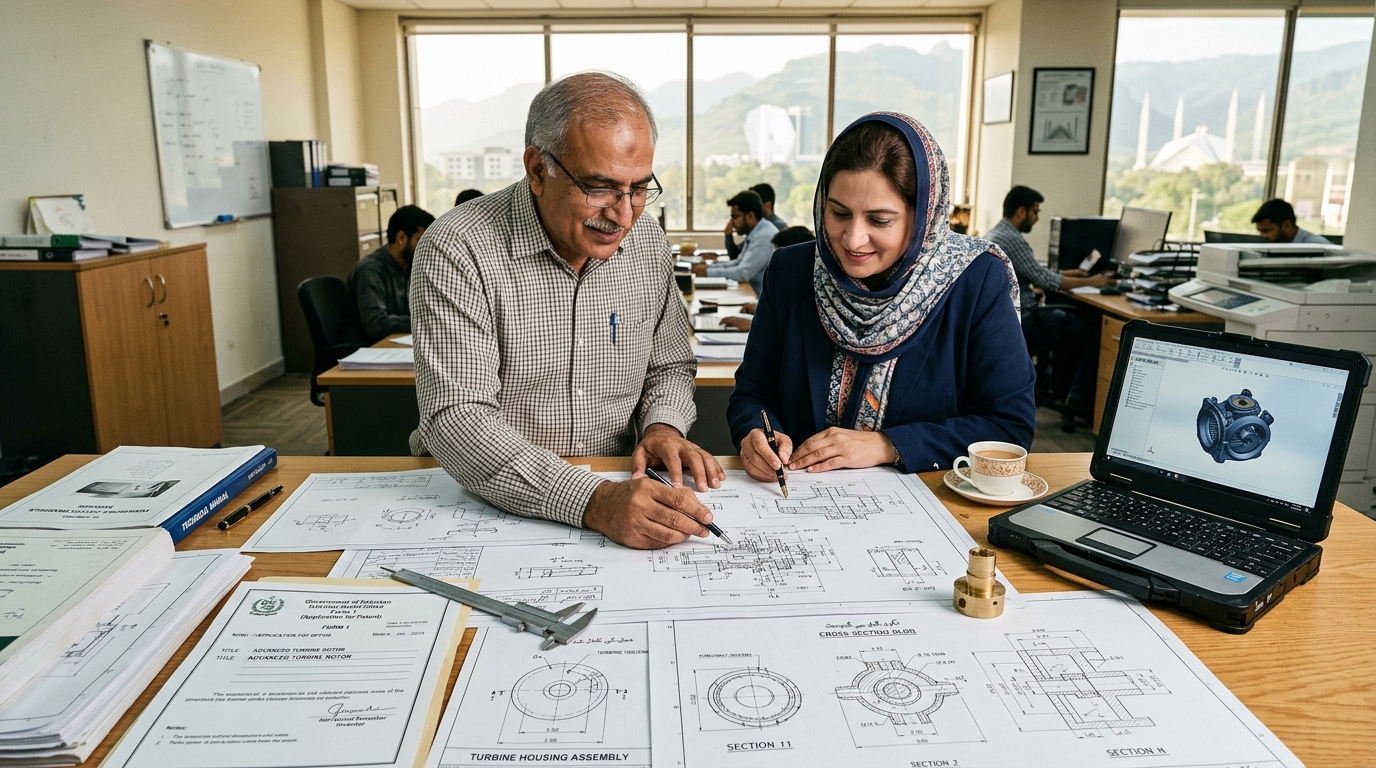
Technical drawings in patent filings are not artistic renderings; they are strict geometric engineering diagrams governed by Rule 21 of the Patents Rules, 2003:
Under Section 21 of the Patents Ordinance, 2000, once a patent application is published and substantive examination is requested, a Patent Examiner scrutinizes the application against global prior art databases.
| Prosecution Stage | Action Required | Statutory Timeline | | :--- | :--- | :--- | | 1. Application Filing | Submit Complete Specification on Form P-1/P-3 with claims and drawings. | Day 0 (establishes priority date). | | 2. Prior Art Search | Patent Office conducts global novelty and inventive step prior art review. | Months 3–6. | | 3. Examination Report | Controller issues First Examination Report (FER) listing substantive objections. | Months 6–12. | | 4. Response & Amendments | Applicant files amended claims and technical rebuttal to FER. | Within 12 months of FER issuance. | | 5. Pre-Grant Opposition | Published in official Gazette; 4-month third-party opposition window opens. | 4-month statutory window. | | 6. Patent Sealing | Formal sealing on Form P-10; patent granted for 20-year term from filing date. | Concludes prosecution. |
The Examiner routinely issues a First Examination Report (FER) containing statutory objections. Patent counsel must overcome these objections within the statutory prosecution period:
The Examiner cites prior art patents (US, EP, CN, or WO documents) claiming your invention is anticipated.
The Examiner argues that while no single prior art document anticipates the invention, a person skilled in the art could easily combine Reference A with Reference B to arrive at the solution.
Under Section 10 of the Patents Ordinance, 2000, certain categories are expressly barred from patentability in Pakistan:
SOFTWARE & AI DRAFTING TACTIC: To patent a software-driven or algorithmic invention in Pakistan, you must never claim "a software application" or "an algorithm". Instead, claim an apparatus, system, or computer-implemented method producing a tangible technical effect (e.g., "A system for optimizing bandwidth allocation in telecommunication routers comprising a physical hardware processor, a memory buffer, and network switches configured to...").
During prosecution, applicants frequently amend claims to overcome prior art citations. However, drafting counsel must navigate Section 24 of the Patents Ordinance, 2000:
THE GOLDEN AMENDMENT RULE: No amendment of a specification or claims shall be allowed that introduces matter not in substance disclosed in the specification as originally filed, or that expands the scope of the claims beyond what was initially claimed.
Once an application successfully overcomes examination objections, it is accepted by the Controller and advertised in the official Patent Gazette of Pakistan.
Before lodging a patent application with the Patent Office in Karachi or via the IPO-Pakistan e-filing system, verify compliance against this checklist:
Patent drafting is a demanding discipline within intellectual property law. Precise claim boundaries, proper antecedent basis, and compliance with statutory disclosure rules dictate whether an issued patent can withstand validity challenges.
By structuring claims with systematic hierarchical dependencies, fulfilling the statutory best-mode disclosure requirements of the Patents Ordinance, 2000, and actively prosecuting examination reports, innovators establish durable IP assets.
For patent drafting, cross-border Paris Convention priority filings, freedom-to-operate (FTO) opinions, and Patent Office prosecution, consult our Intellectual Property Practice Group at TaxCalc.pk / Zaidi & Associates.
Legal & Statutory Notice: The information provided in this publication is for general educational, academic, and statutory informational purposes only under the relevant laws of Pakistan (including the Income Tax Ordinance, 2001, the Companies Act, 2017, and the Trade Marks Ordinance, 2001). This content does not constitute formal legal, financial, or tax advice. For specific assessments, consult a licensed Advocate or qualified tax professional.