>
 TaxCalc.pk
FY 2026-27
TaxCalc.pk
FY 2026-27
Avoid the trademark classification trap for Pakistani tech companies. Learn the difference between Class 35, Class 42, and Class 9 for SaaS & apps.
By Syed Asad Hussain Zaidi · 8 September 2026
Author Note / Last Updated: Updated September 2026 by Syed Asad Hussain Zaidi | Advocate High Court | Professional Tax Consultant
In Pakistan’s rapidly accelerating digital economy, tech founders and digital agency owners are building remarkable commercial enterprises. Software houses in Lahore export custom code across North America, fintech startups in Karachi process millions of daily peer-to-peer transactions, and e-commerce marketplaces in Islamabad connect thousands of merchants with nationwide buyers.
Yet, when it comes to safeguarding their brand identity with the Trade Marks Registry of IPO-Pakistan, tech executives frequently fall victim to a subtle, catastrophic classification blunder: the confusion between Trademark Class 35 and Trademark Class 42.
Every year, our legal practice encounters tech founders in acute commercial distress:
In trademark law, your protection is strictly confined to the specific classes and specifications of goods and services listed on your Form TM-1.
Administered under the Trade Marks Ordinance, 2001 and the international Nice Classification (12th Edition), understanding the precise boundary between Class 35, Class 42, and Class 9 is the difference between an unassailable tech brand and an expensive, forced corporate rebranding.
This definitive 2026 strategic guide clarifies the exact operational differences between these classes and outlines a battle-tested classification framework for Pakistani tech enterprises.
Pakistan officially follows the Nice Agreement Concerning the International Classification of Goods and Services for the Purposes of the Registration of Marks.
The Nice Classification organizes all commercial trade into 45 distinct classes:
Under Pakistani registry rules, government application fees are levied on a per-class basis (e.g., submitting Form TM-1 across three classes incurs three separate government fee challans). To save money, boot-strapped Pakistani startups often pick only one class—and far too often, they pick the wrong one.
Class 35 is one of the most widely registered service classes in Pakistan, but its legal scope is widely misunderstood by the tech sector.
"Advertising; business management, organization and administration; office functions; retail and wholesale services."
Class 35 does not protect the writing of computer code or the underlying software technology. It protects business operations, promotional activities, and retail facilitation:
[!WARNING]
The SaaS Fallacy: Many B2B SaaS founders argue: "Our software helps corporate human resource departments manage employee payroll; therefore, we provide business administration under Class 35." The Trade Marks Registry strictly rejects this logic. You are not providing human resource services; you are licensing a technological software tool that enables the client to conduct their own HR operations. Your core service is technological (Class 42), not managerial (Class 35)!
Class 42 is the true legal home of the software engineer, cloud architect, and technological innovator.
"Scientific and technological services and research and design relating thereto; industrial analysis and research services; design and development of computer hardware and software."
Class 42 covers the creation, engineering, maintenance, and hosting of digital technology:
When planning an intellectual property strategy for a digital product, tech founders often focus solely on service classes (35 and 42) and overlook the most fundamental asset: the mobile application itself.
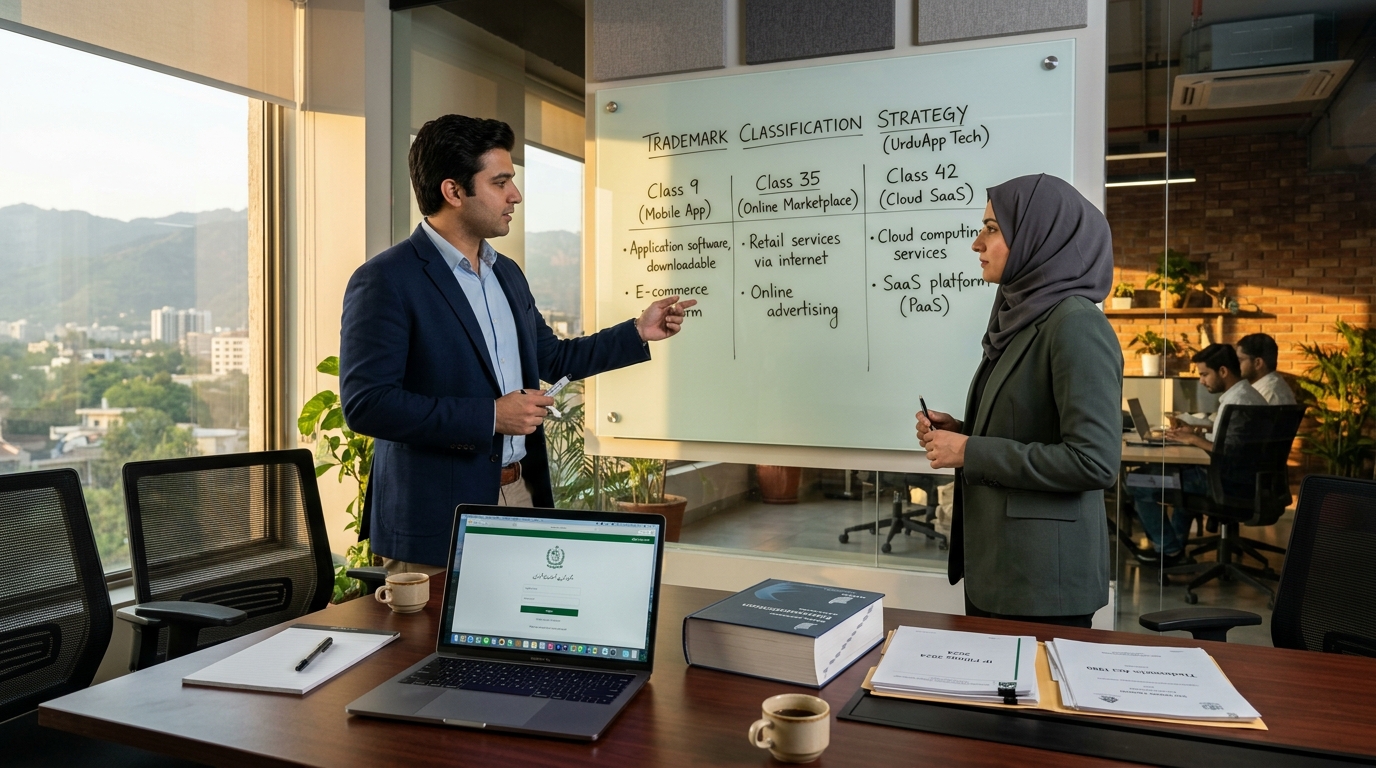
| Class | Strategic Scope | Delivery Channel | Practical Tech Examples | | :--- | :--- | :--- | :--- | | Class 9 | Downloadable Software Products | APK / iOS bundles on app stores, firmware, offline desktop programs. | Consumer mobile app installed on user devices. | | Class 35 | Commercial Marketplace & Advertising | Multi-vendor digital platforms, retail store services, online marketing. | Aggregation portal connecting merchant sellers with retail buyers. | | Class 42 | Hosted Cloud Software & SaaS | Browser-accessible cloud SaaS, backend API infrastructure, cybersecurity. | Web-hosted dashboard, database engines, cloud enterprise software. |
Under Nice Classification jurisprudence:
If you operate a consumer-facing mobile app (such as an on-demand ride-hailing app, digital banking wallet, or food delivery app) and fail to register in Class 9:
To understand how top-tier Pakistani technology companies architect their trademark filings, examine the multi-class strategies deployed across different digital business models:
| Business Type / Operation | Primary Class | Secondary Class | Defensive Class | | :--- | :--- | :--- | :--- | | Custom Software Development Agency | Class 42 (Software design) | Class 9 (Software programs) | Class 35 (IT business consulting) | | SaaS Cloud Platform (Web-based) | Class 42 (SaaS / Cloud hosting) | Class 9 (Companion app) | Class 35 (Business administration) | | Online E-Commerce Marketplace | Class 35 (Marketplace / Retail) | Class 9 (Downloadable app) | Class 39 (Logistics / Delivery) | | Digital Performance Marketing Agency | Class 35 (Advertising / Marketing) | Class 42 (Web design) | Class 41 (Training / Webinars) | | Fintech / Payment Gateway | Class 36 (Financial services) | Class 9 (App software) | Class 42 (SaaS gateway) | | On-Demand Ride/Delivery App | Class 9 (Navigation / Ride app) | Class 39 (Transport / Courier) | Class 42 (GPS tracking SaaS) |
A common mistake made by Pakistani applicants is copying generic, one-line class headings from Google (e.g., writing simply "Class 42: Computer services"). Overly broad or vague descriptions invite immediate official objections from the Trade Marks Registry.
Your IP attorney should draft a precise, tailored Specification of Services that accurately reflects your business while providing expansive legal room for growth:
"Software-as-a-service (SaaS) featuring software for [describe function, e.g., enterprise resource planning, financial accounting, and tax calculation]; design and development of computer software and mobile applications; cloud computing services; hosting of websites and web-based applications; computer programming services; IT architecture consulting and technological advisory services; providing temporary use of non-downloadable cloud software platforms."
"Provision of an online marketplace for buyers and sellers of goods and services; retail and wholesale services connected with the sale of [specify products, e.g., consumer electronics, apparel, FMCG goods] via global computer networks; online advertising and promotional marketing services; business management, organization, and commercial administration assistance for third parties."
"Downloadable computer software and mobile applications for [specify function, e.g., online shopping, financial transactions, electronic payments, and business management]; downloadable computer application software for mobile phones, tablets, and smart devices; computer software platforms, recorded or downloadable; electronic publications downloadable from the internet."
If your tech startup is operating on limited capital and cannot afford to pay government fees across three or four classes simultaneously, adopt a phased filing strategy:
| Growth Phase | Filing Strategy | Tactical Class Prioritization | | :--- | :--- | :--- | | Phase 1: Pre-Launch / MVP | Anchor Core Revenue Engine | • Pure SaaS: Prioritize Class 42.<br>• E-commerce Marketplace: Prioritize Class 35.<br>• Consumer Mobile App: Prioritize Class 9. | | Phase 2: Post-Funding / Scale | Defensive Perimeter Expansion | • Expand into auxiliary classes (e.g. SaaS platforms add Class 9 app and Class 35 retail).<br>• File international applications via Madrid System for export markets. |
* If you license a cloud platform to corporate clients over the web, prioritize Class 42. * If you take a commission connecting buyers with third-party sellers, prioritize Class 35.
Disclaimer: This guide is prepared for informational and strategic educational purposes. Trademark classifications and registry practices involve strict statutory definitions and evolving administrative standards. Consult an Advocate High Court or accredited trademark practitioner for formal legal evaluation of your tech enterprise.
Legal & Statutory Notice: The information provided in this publication is for general educational, academic, and statutory informational purposes only under the relevant laws of Pakistan (including the Income Tax Ordinance, 2001, the Companies Act, 2017, and the Trade Marks Ordinance, 2001). This content does not constitute formal legal, financial, or tax advice. For specific assessments, consult a licensed Advocate or qualified tax professional.