>
 TaxCalc.pk
FY 2026-27
TaxCalc.pk
FY 2026-27
Master trademark classification strategy in Pakistan. Learn multi-class filings, defensive registrations, goods specification, and cost optimization.
By Syed Asad Hussain Zaidi · 8 September 2026
Author Note / Last Updated: Updated September 2026 by Syed Asad Hussain Zaidi | Advocate High Court | Senior IP & Corporate Counsel.
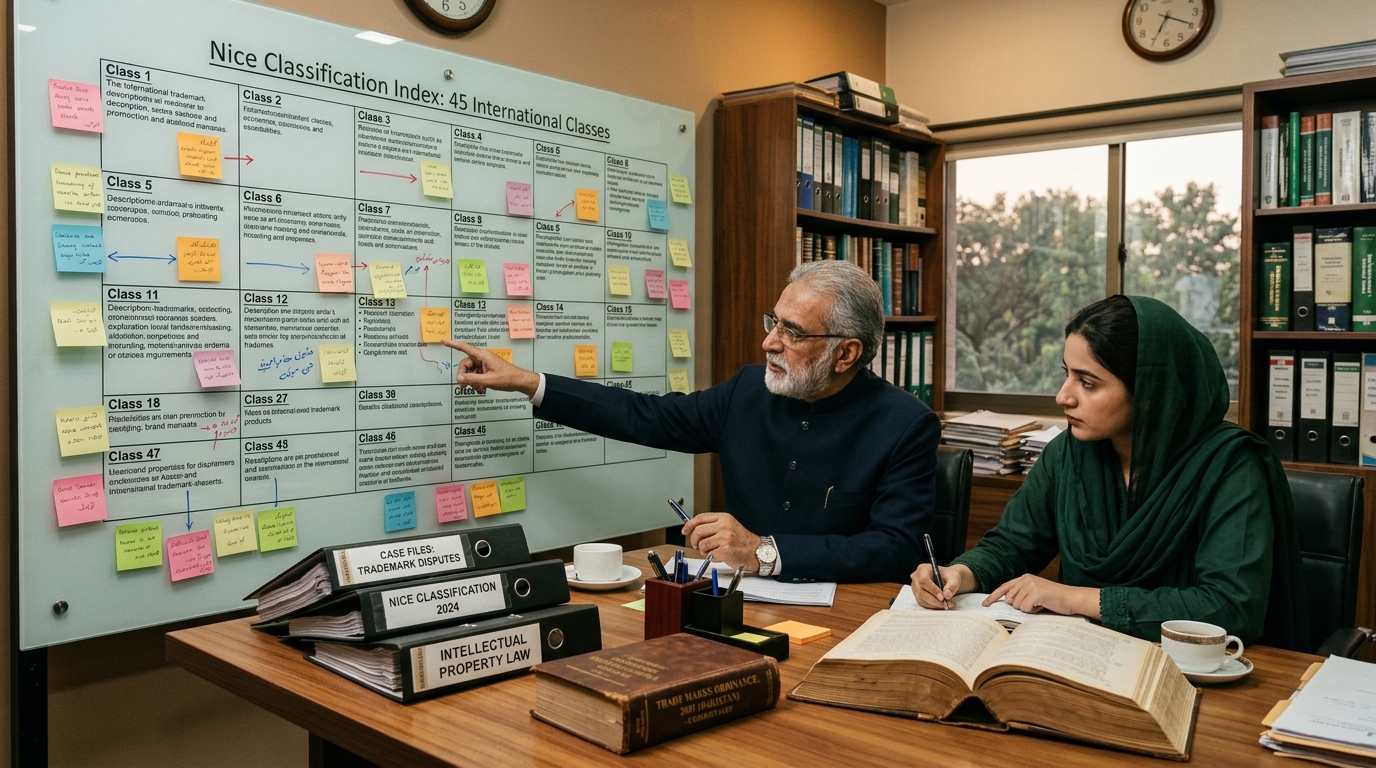
In trademark law, the scope of statutory monopoly granted by a Certificate of Registration is determined not merely by the brand name or logo itself, but by the precise classes of goods and services specified in the application. Under the Trade Marks Ordinance, 2001 and the Trade Marks Rules, 2004, Pakistan adheres to the international classification system established under the Nice Agreement Concerning the International Classification of Goods and Services for the Purposes of the Registration of Marks (12th Edition).
The Nice Classification divides all commercial activity into 45 distinct statutory classes—comprising 34 classes for physical goods (Classes 1 through 34) and 11 classes for services (Classes 35 through 45).
For corporate counsel, serial founders, and high-growth consumer enterprises, selecting the correct classes is not a ministerial box-ticking exercise. It is a strategic corporate defense operation. A misclassified product leaves core revenue streams unprotected against imitators, while an overly broad or imprecise specification invites substantive examiner show-cause notices under Section 27, costly opposition hearings, or aggressive non-use revocation petitions from competitors under Section 73.
This master guide dissects advanced trademark classification strategies, defensive filing architectures, goods specification drafting, and portfolio cost optimization under Pakistani legal practice.
Before structuring a multi-class portfolio, brand owners must understand the foundational legal constraints imposed by the Trade Marks Registry of IPO-Pakistan:
Unlike international jurisdictions (such as the United States USPTO or the European Union EUIPO) that permit a single unified application covering multiple classes, Pakistan maintains a strict single-class per application requirement.
Under Section 21(2), the applicant must specify the precise goods or services for which registration is sought. In Pakistani practice, copying and pasting the generic, broad Class Headings published by WIPO is a fatal mistake.
| Classification Division | Nice Classes | Primary Characteristics | Representative Pakistani Sectors | | :--- | :--- | :--- | :--- | | Manufactured Goods | Classes 1 to 34 | Tangible physical items and commodities. | FMCG, textiles, pharma, electronics, chemicals, engineering. | | Commercial Services | Classes 35 to 45 | Intangible business activities and labor. | Retail, software/SaaS, banking, hospitality, logistics, education. |
The following reference chart categorizes all 45 classes into primary commercial sectors relevant to Pakistani business and manufacturing:
The most dangerous classification errors occur in digital technology, SaaS, and fintech enterprises. Founders frequently assume that filing in one tech-sounding class provides umbrella protection across their entire digital business. In Pakistani jurisprudence, this assumption is legally invalid:
| Commercial Offering | Proper Nice Class | Legal Distinction & Judicial Rationale | | :--- | :--- | :--- | | Downloadable Code / Mobile App | Class 9 (Goods) | The executable binary file (APK, iOS bundle) is downloaded and installed on user hardware. It is legally treated as a physical good. | | Cloud SaaS Platform (Web App) | Class 42 (Services) | Software accessed over the browser without permanent local download. It is a technical engineering and hosting service. | | Online E-Commerce Marketplace | Class 35 (Services) | Providing a commercial platform bringing buyers and sellers together. It is a retail and marketing service, not a software product. | | Digital Wallet / Payment Gateway| Class 36 (Services) | Processing payments, escrow accounts, digital currency exchange, and ledger management. It is a regulated financial service. |
| Core Tech Class | Scope & Delivery Channel | Practical Tech Platform Example | | :--- | :--- | :--- | | Class 9 (Goods) | Downloadable software, mobile apps (APK / iOS bundles), firmware. | Native mobile applications installed on end-user smartphones. | | Class 42 (Services) | Non-downloadable cloud SaaS, hosted APIs, web apps, cybersecurity. | Browser-accessed business dashboard or cloud infrastructure. | | Class 35 (Services) | Online multi-vendor marketplace, aggregation, e-commerce retail. | Digital marketplace connecting independent merchants with consumers. | | Class 36 (Services) | Payment gateways, microfinance wallets, digital escrow services. | Regulated financial technology and cashless checkout rails. |
The Strategic Imperative: A fintech company that only registers in Class 9 cannot stop a competitor from launching a web-based payment portal under the same name in Class 36. High-growth technology platforms must execute coordinated filings across Classes 9, 35, 36, and 42.
Under Pakistani commercial conditions, brand squatters routinely monitor promising early-stage companies and file opportunistic trademark applications in complementary classes where the original founder failed to file.
A defensive filing is an application submitted in adjacent or logically related classes to create a legal barrier, even if the business is not currently manufacturing those specific items.
Under Section 17(3) of the Trade Marks Ordinance 2001, a registered trademark owner can block confusingly similar marks in identical or similar goods. However, proving that goods are "similar" in a contested opposition hearing before the Registrar is fraught with litigation risk and factual ambiguity. By securing defensive registrations in advance, the business acquires absolute statutory ownership across the entire competitive spectrum without needing to litigate subjective product overlap.
- Class 35 (Retail clothing boutique and online store services). - Class 3 (Perfumes, cosmetics, and personal grooming). - Class 14 (Jewelry and watches).
- Class 30 (Packaged spices, sauces, confectionery, tea, coffee). - Class 32 (Branded bottled mineral water, beverages). - Class 35 (Franchise administration and retail sales management).
- Class 19 (Non-metallic construction materials, cement, tiles). - Class 42 (Architectural design and urban planning engineering).
While defensive registrations provide unmatched strategic insulation, legal counsel must carefully manage the statutory vulnerability introduced by Section 73 of the Trade Marks Ordinance, 2001 (Revocation on grounds of non-use).
Under Section 73(1)(b), any aggrieved person can apply to the High Court or the Registrar for the expungement (removal) of a registered trademark if:
Because Pakistan charges registry fees on a per-class basis, enterprises must allocate IP budgets strategically across their product roadmap:
| Strategic Tier | Priority & Horizon | Class Composition | Commercial Objective | | :--- | :--- | :--- | :--- | | Tier 1: Core Target | Year 1 Priority | Primary operational classes (e.g., Class 25 + Class 35) | Immediate revenue generation and core trademark shielding. | | Tier 2: Defensive Perimeter | Year 2–3 Expansion | Adjacent merchandise & accessories (e.g., Class 18 + Class 3) | Preempting squatters and brand dilution across logical extensions. |
| Portfolio Scope | Number of Form TM-1 Filings | Government Filing Fees (Rs. 3,000 / class) | Government Final Reg Fees (Rs. 9,000 / class) | 10-Year Renewal Fee (Rs. 15,000 / class) | | :--- | :--- | :--- | :--- | :--- | | Single Core Class | 1 Application | Rs. 3,000 | Rs. 9,000 | Rs. 15,000 | | Dual Defense (e.g., 25 + 35) | 2 Applications | Rs. 6,000 | Rs. 18,000 | Rs. 30,000 | | Full Tech Quad (9, 35, 36, 42) | 4 Applications | Rs. 12,000 | Rs. 36,000 | Rs. 60,000 | | Enterprise Moat (6 Classes) | 6 Applications | Rs. 18,000 | Rs. 54,000 | Rs. 90,000 |
A trademark registration is only as strong as the statutory class boundaries that surround it. Confining your brand to a single narrow classification saves modest government fees upfront, but exposes your company to debilitating brand infringement, competitor hijacking, and costly High Court litigation downstream.
By auditing your commercial roadmap, deploying defensive filings around core business verticals, avoiding high-tech classification traps, and drafting legally precise specifications, your enterprise can construct an impenetrable intellectual property barrier across Pakistan.
Need an expert multi-class portfolio audit or assistance navigating complex classification conflicts before IPO-Pakistan? Consult with an experienced High Court IP advocate to ensure comprehensive protection for your commercial marks.
Legal & Statutory Notice: The information provided in this publication is for general educational, academic, and statutory informational purposes only under the relevant laws of Pakistan (including the Income Tax Ordinance, 2001, the Companies Act, 2017, and the Trade Marks Ordinance, 2001). This content does not constitute formal legal, financial, or tax advice. For specific assessments, consult a licensed Advocate or qualified tax professional.