Overcome trademark refusal in Pakistan. Learn Section 14 absolute and Section 17 relative grounds under Trade Marks Ordinance 2001 and TM-9 replies.
By Syed Asad Hussain Zaidi · 8 September 2026
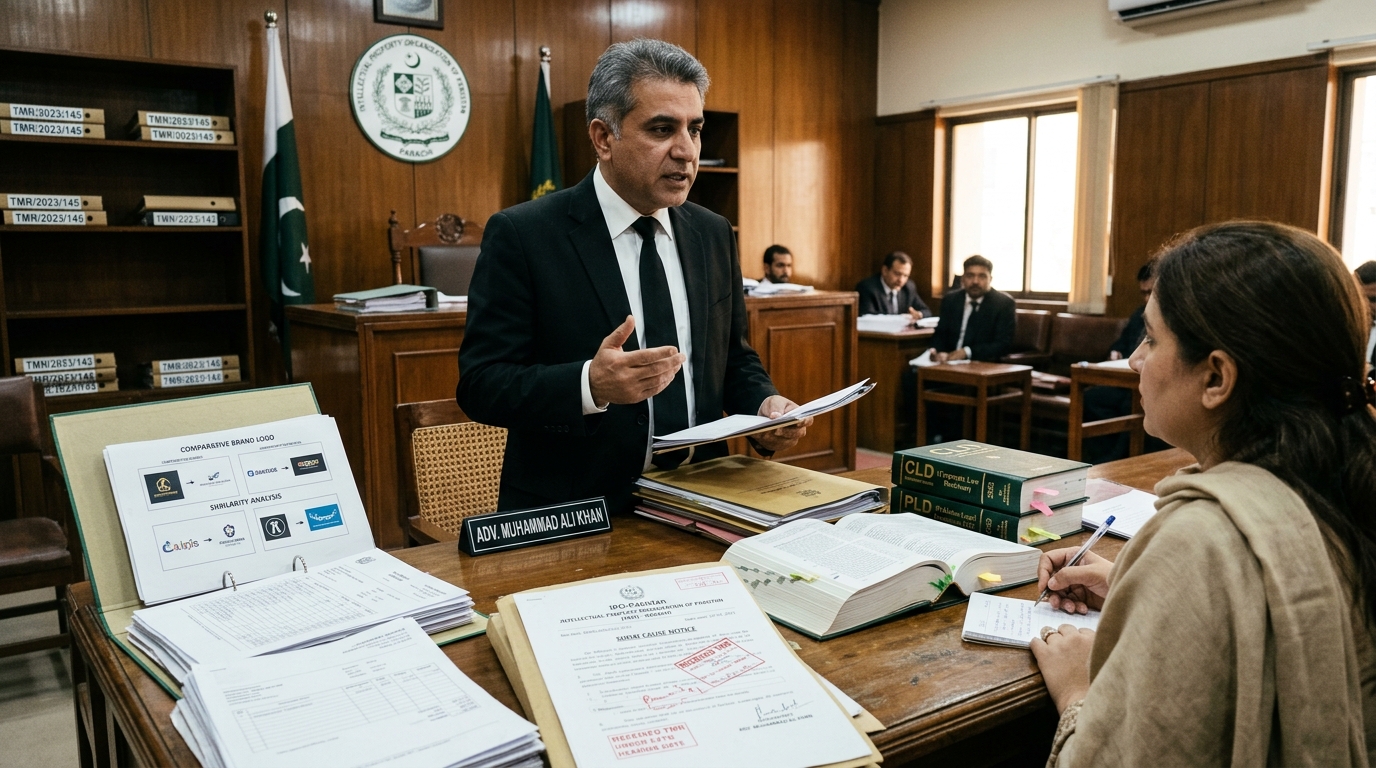
Author Note / Last Updated: Updated September 2026 by Syed Asad Hussain Zaidi | Advocate High Court | Professional Tax Consultant Filing an application for trademark registration via Form TM-1 with the Trade Marks Registry (TMR) of IPO-Pakistan is often viewed by entrepreneurs as a simple administrative task: fill in the form, pay the government fee challan, and wait for the registration certificate. In reality, the trademark examination process in Pakistan is a rigorous quasi-judicial proceeding. According to registry data, over 60% of all trademark applications filed in Pakistan face an official objection or refusal during the initial substantive examination stage. Instead of an acceptance letter, the applicant receives a dreaded official communication: a Show Cause Notice (Form TM-9) issued by the Examiner of Trade Marks, warning that the proposed mark cannot be registered and scheduling a mandatory hearing to show cause why the application should not be refused. For an unprepared business owner, receiving a TM-9 notice can trigger panic. However, an examiner’s objection is not a death sentence for your brand. Under Pakistani trademark jurisprudence, objections fall into distinct statutory categories, each with established legal pathways for rebuttal. This definitive 2026 legal guide breaks down the two statutory pillars of trademark refusal in Pakistan—Absolute Grounds (Section 14) and Relative Grounds (Section 17) of the Trade Marks Ordinance, 2001—and provides proven legal strategies to overcome examiner objections. --- The Examination Architecture: How IPO-Pakistan Evaluates Your Mark When Form TM-1 is submitted, an Examiner of Trade Marks at the principal registry in Karachi (or regional offices in Lahore and Islamabad) scrutinizes the proposed mark through a two-stage statutory filter: If the mark fails either of these statutory tests, the Registrar issues an official Examination Report / Show Cause Notice (Form TM-9) under Rule 23 of the Trade Marks Rules, 2004. --- Absolute Grounds for Refusal (Section 14) Section 14 of the Trade Marks Ordinance, 2001 governs Absolute Grounds for Refusal. These objections relate to the intrinsic nature of the proposed mark itself, completely independent of what other businesses have registered. Ground 1: Marks Devoid of Distinctive Character (Section 14(1)(a)) A trademark’s core statutory purpose is to distinguish the goods or services of one enterprise from those of another. If a mark is too simple, generic, or common, it is deemed devoid of distinctive character. Examples of Refusal: A single basic geometric shape (e.g., a simple unadorned circle or square), a single common letter or number without unique graphic stylization, or ordinary laudatory marketing phrases (e.g., "The Best" or "Top Quality"*). Ground 2: Exclusively Descriptive Marks (Section 14(1)(b)) This is the single most frequent ground for refusal in Pakistan. The law prohibits the monopolization of words that directly describe the: Kind or Quality: (e.g., attempting to register "Crispy" for potato chips, "Pure" for cooking oil, or "Fast"* for courier services). Quantity or Value: (e.g., "1000 Grams" or "Budget"*). Intended Purpose: (e.g., "Pain Relief" for analgesic tablets or "Insect Killer"* for pesticides). Geographical Origin: Words indicating geographic locations celebrated for specific products (e.g., "Multani" for clay/halwa, "Kasuri" for methi, or "Lahori"* for food). [!NOTE] The Public Policy Behind Section 14(1)(b): The Supreme Court of Pakistan has repeatedly ruled that honest merchants must remain free to use ordinary descriptive words to describe their merchandise. No single trader should be granted a private monopoly over common Urdu or English adjectives that their competitors need to describe their own goods. Ground 3: Customary and Generic Terms (Section 14(1)(c)) Marks that consist exclusively of words or signs that have become customary in the current language or in the bona fide and established practices of the trade will be rejected. Example: Attempting to register the word "Pharmacy" for a medical dispensary or "Chai"* for a tea house. Ground 4: Deceptive or Misleading Marks (Section 14(3)(a)) A mark is refused if it is of such a nature as to deceive the public, particularly regarding the nature, quality, or geographical origin of the goods. Example: Applying for the mark "Swiss Gold Watches" for watches manufactured in an industrial unit in Gujranwala using non-gold alloy; or labeling synthetic blended oil as "100% Organic Cold-Pressed Olive Oil"*. Ground 5: Prohibited, Scandalous, and Religious Marks (Section 14(3)(b) & Special Provisions) Pakistan maintains strict statutory bans on marks that: Are contrary to public order or morality; Contain scandalous or blasphemous depictions; Contain holy names, Quranic verses, names of the Holy Prophet (PBUH), Caliphs, Ahl al-Bayt, or revered religious figures (explicitly barred under Gazette notifications and Registry practice); Feature the National Flag of Pakistan, the State Emblem, official military insignia, or the Red Crescent emblem without prior written authorization from the Federal Government under the Emblems and Names (Prevention of Improper Use) Act, 1957*. --- The Great Exception: Acquired Distinctiveness (Section 14(2)) There is a powerful legal exception to absolute grounds: the Proviso to Section 14(2). The statute explicitly states that a trademark shall not be refused registration under Section 14(1)(a), (b), or (c) if, prior to the date of application, it has in fact acquired a distinctive character as a result of the use made of it. In intellectual property jurisprudence, this is known as "Secondary Meaning". If your brand name was originally somewhat descriptive or laudatory, but you can prove through documentary evidence that you have openly, continuously, and extensively used the mark in Pakistan for several years such that the purchasing public associates that name exclusively with your enterprise, the Registrar must waive the absolute objection and accept the mark for registration. --- Relative Grounds for Refusal (Section 17) While Section 14 examines the mark in isolation, Section 17 examines the mark in the context of the marketplace. Relative grounds protect the prior legal rights of existing trademark owners and safeguard consumers against confusion. The Conflict Matrix under Section 17 | Statutory Provision | Proposed Mark vs. Earlier Mark | Goods/Services Comparison | Legal Standard for Refusal | | :--- | :--- | :--- | :--- | | Section 17(1) | Identical to an earlier registered mark | Identical goods or services | Absolute Refusal: No confusion needs to be proven; direct collision. | | Section 17(2) | Identical or Similar to an earlier registered mark | Similar or Related goods or services | Likelihood of Confusion: Includes the likelihood of association. | | Section 17(4) | Identical or Similar to a Well-Known mark | Unrelated / Dissimilar goods or services | Refused if the mark takes unfair advantage of or dilutes the well-known mark. | The Tests for Deceptive Similarity Applied by Pakistani Courts When an examiner cites an earlier registered trademark under Section 17(2), Pakistani High Courts evaluate deceptive similarity using the Trilogy of Similarity Tests: Visual Similarity (The Eye Test): Looking at the marks side by side and in isolation. Are the typographic structures, color palettes, or visual silhouettes substantially similar? Phonetic Similarity (The Ear Test): When pronounced in Urdu or English, do the marks sound identical or confusingly close? (e.g., "Pianotune" vs. "Pianist", or "Shan" vs. "Shaan"). Courts consider how the names are pronounced in crowded Pakistani wholesale bazaars by ordinary citizens with average intelligence and imperfect recollection. Conceptual Similarity (The Idea Test): Do both marks convey the exact same mental image or concept? (e.g., a graphic logo of an charging tiger vs. a word mark "Sher" in the same class). --- The TM-9 Notice and the 2-Month Statutory Deadline When the Examiner raises objections under Section 14 or Section 17, they issue an official Notice of Hearing / Show Cause Notice (Form TM-9). [!WARNING] Strict Statutory Abandonment: Under Rule 23 of the Trade Marks Rules, 2004, the applicant must formally respond or appear within two months from the date of receipt of the examination notice. If you ignore the TM-9 notice, the Registrar will record the application as "Abandoned for Non-Prosecution". Once an application is deemed abandoned, your priority date is permanently lost, and the government fees are forfeited! --- Proven Strategies to Overcome Examiner Objections An experienced Advocate High Court utilizes distinct procedural and substantive legal tools to overcome examination reports: Strategy 1: Submitting Evidence of Acquired Distinctiveness (Section 14(2)) If your mark is objected to as descriptive, file an Affidavit of Evidence of Use affirmed before an Oath Commissioner, supported by: FBR Sales Tax & Income Tax Challans: Showing extensive commercial turnover under the brand name across multiple tax years. Specimen Invoices & Bills of Lading: Showing commercial distribution across multiple cities (e.g., Karachi, Lahore, Rawalpindi, Peshawar, Faisalabad). Media & Advertising Expenditure: Tax invoices from digital marketing agencies, TV commercials, outdoor billboards, and print publications demonstrating public recognition. Strategy 2: Entering a Statutory Disclaimer (Section 16) If your composite mark consists of a distinctive logo combined with a descriptive word (e.g., an artistic falcon emblem alongside the phrase "Fast Cargo Services"): The applicant can submit a formal Disclaimer under Section 16: "Registration of this mark shall give no right to the exclusive use of the descriptive word 'Fast Cargo Services' separately and apart from the mark as a whole." By disclaiming the generic word, you satisfy the examiner's concern while successfully securing statutory registration for the distinctive logo and overall layout. Strategy 3: Pleading "Honest Concurrent Use" (Section 19) If the examiner cites an earlier conflicting mark under Section 17, but you have been using your brand openly in Pakistan for years alongside the cited mark without actual consumer confusion: The Registrar has statutory discretion under Section 19 to permit the registration of identical or confusingly similar marks by more than one proprietor in cases of Honest Concurrent Use. You must demonstrate honesty in the initial adoption of the mark, duration of concurrent use, volume of trade, and geographical separation of operations. Strategy 4: Narrowing the Goods or Services Often, an examiner cites an earlier mark because your TM-1 application used overly broad class headings (e.g., "All goods in Class 30"). If the cited earlier mark only sells "Biscuits", and your product is exclusively "Herbal Green Tea", your attorney can file an amendment restricting your specification of goods exclusively to "Herbal green tea; none of the aforesaid including biscuits or confectionery."* Eliminating the commercial overlap removes the likelihood of confusion, allowing the examiner to waive the Section 17 objection. Strategy 5: Coexistence Agreement or Letter of Consent Under Section 17, if the owner of the earlier cited mark signs a formal, notarized Letter of Consent or Coexistence Agreement stating they have no objection to your registration, the Registrar will generally waive the relative objection and allow your mark to proceed to publication. --- What if the Registrar Issues a Final Order of Refusal? If the Assistant Registrar remains unconvinced following oral arguments at the TM-9 hearing, they will issue a formal written order refusing the application. This does not end your legal options: Request for Grounds of Decision (Form TM-15): Within one month of the refusal order, the applicant can file Form TM-15 compelling the Registrar to issue a comprehensive written judgment stating the exact statutory grounds and legal reasons for refusal. Statutory Appeal to the High Court (Section 114): Under Section 114 of the Trade Marks Ordinance, 2001, any person aggrieved by a final decision of the Registrar has the right to file an Appeal before the High Court (e.g., Sindh High Court, Lahore High Court, Islamabad High Court) within two months of the date of the order. The High Court reviews the administrative decision on legal merit, often overturning overzealous examiner rejections and directing the Trade Marks Registry to advertise the mark in the official Trade Marks Journal. --- Action Checklist When Facing a Trademark Objection Track the Date of Receipt: Note the exact day you or your legal agent received the TM-9 notice to calculate your strict 2-month deadline. Obtain the Official Search File: Review the exact citations raised by the examiner. Are they absolute (Section 14) or relative (Section 17)? Compile Documentary Proof of Use: Collect dated sales tax invoices, marketing receipts, and packaging specimens dating back to your claimed first date of use. Evaluate Disclaimer Options: Consult with your IP lawyer to determine whether entering a disclaimer over descriptive text resolves the objection without diluting your brand identity. Never Miss the Hearing: Attend the hearing before the Assistant Registrar represented by an Advocate High Court experienced in Trade Marks Registry procedures. --- Disclaimer: This guide is prepared for educational and professional informational purposes. Responding to trademark show-cause notices and prosecuting appeals before the High Court involve specialized statutory procedure. Consult an Advocate High Court or registered trademark practitioner for formal legal representation.