>
 TaxCalc.pk
FY 2026-27
TaxCalc.pk
FY 2026-27
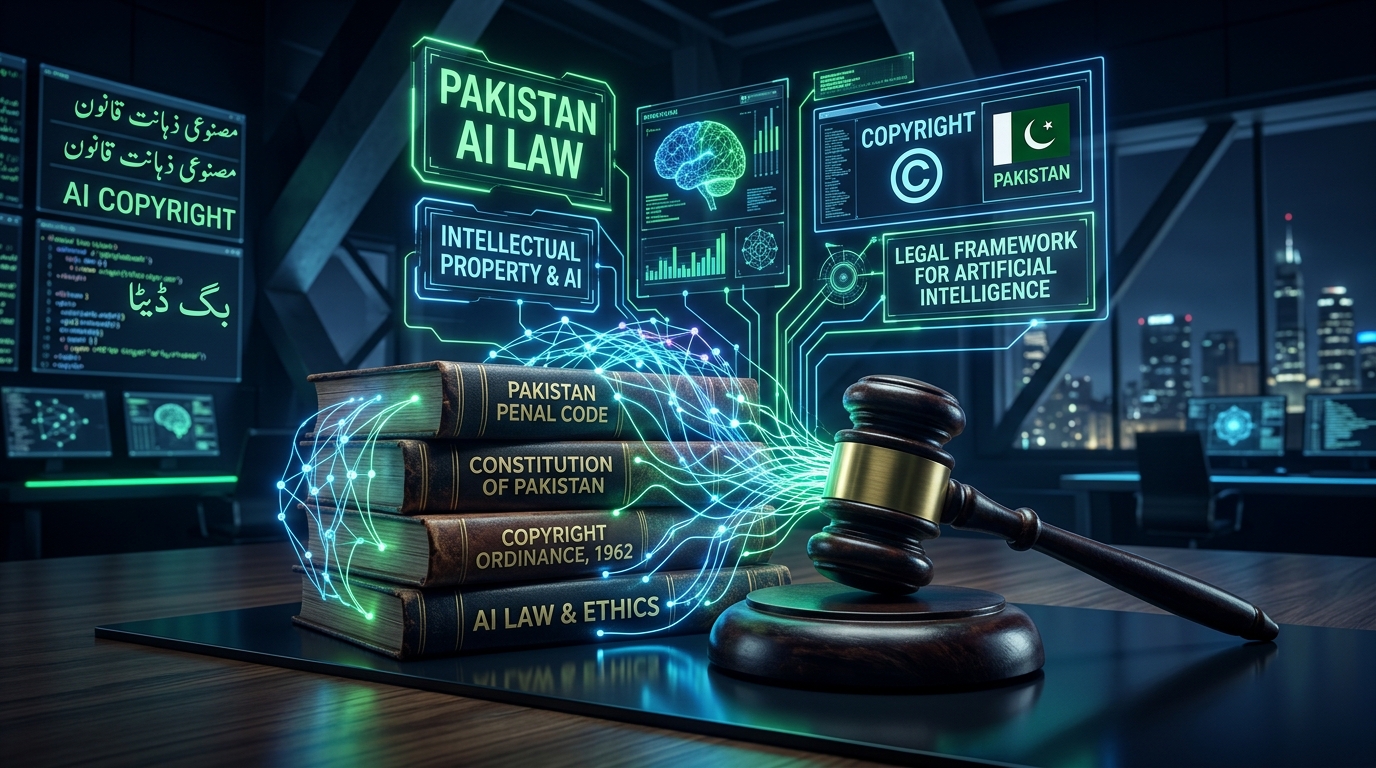
Who owns code and creative works generated by ChatGPT, GitHub Copilot, or Midjourney under Pakistani law? Deep analysis of the human authorship requirement under the Copyright Ordinance 1962.
By Syed Asad Hussain Zaidi · 9 September 2026
[Tax Year 2026 Framework]
- Updated for FY 2026 compliance.
- Reflects current FBR and SECP statutory requirements.
The widespread adoption of generative artificial intelligence models—including OpenAI's ChatGPT, Anthropic's Claude, GitHub Copilot, Cursor, Midjourney, and Stable Diffusion—has revolutionized software development, digital publishing, and commercial content generation across Pakistan's tech ecosystem. Software developers now generate complex backend functions using AI prompts, digital agencies produce commercial illustrations in seconds, and content writers deploy automated workflows to produce high-volume marketing copy.
However, this explosive operational efficiency has created profound legal ambiguity: Can an AI-generated software application, digital illustration, or commercial article receive legal copyright protection under Pakistani law? And who faces liability when an AI model outputs code or text copied from third-party protected repositories?
Navigating these challenges requires examining the fundamental principles of originality, authorship, and intellectual property ownership embedded within the Copyright Ordinance, 1962.
Pakistani copyright law is rooted in human creative intellectual labor. Section 2(d) of the Copyright Ordinance 1962 defines an "author" across various categories:
In legal interpretation, an "author", "composer", or "artist" has consistently been held by the High Courts of Pakistan to denote a natural human person possessing legal capacity and intellectual intent. An artificial intelligence system—regardless of how sophisticated its neural network parameters may be—possesses no legal personhood, cannot execute contracts, cannot be sued for damages, and cannot own property.
If a piece of software or digital artwork is generated 100% autonomously by an AI model in response to a single generic prompt (e.g., "Write an inventory management software in Python"), no copyright is created under Pakistani law. The resulting output enters the public domain immediately upon generation, meaning any competitor can freely copy, modify, and resell the code without infringing any intellectual property rights.
To secure legal copyright protection for software or content developed using AI tools, the human creator must demonstrate substantial human intellectual contribution. Pakistani jurisprudence follows the established common-law doctrine of "skill, judgment, and labor":
| Level of AI Involvement | Legal Description | Copyright Status in Pakistan | | :--- | :--- | :--- | | Pure Autonomous Generation | User provides simple prompt; AI outputs entire function | No Copyright: Falls into public domain | | Iterative Human-AI Collaboration | Human designs system architecture, refines prompts, debugs logic | Protected: Copyright vests in the human developer | | AI as Assistive Copilot | Human writes core code; AI assists with autocompletion and syntax | Fully Protected: Standard human author copyright | | AI Infringing Output | AI replicates protected code snippets from third-party training data | Infringement Risk: Human user/firm strictly liable |
Generative AI models do not synthesize code or images from nothingness; they are trained on massive datasets scraped from the public web, including open-source repositories licensed under copyleft terms (GPL, AGPL) and proprietary copyrighted content.
If an AI code assistant reproduces a 200-line block of proprietary code verbatim from an existing copyrighted software package, and your developers incorporate that snippet into a commercial enterprise SaaS product:
## TaxCalc Advisory Insights: Mandatory Corporate AI Use Policies
Every Pakistani tech company, digital marketing agency, and software house must immediately institute a formal Corporate Generative AI Policy. This policy should explicitly prohibit employees from pasting confidential client source code, customer personal data, or trade secrets into public AI tools where training data retention is enabled. Furthermore, developers must be contractually required to disclose AI usage and run automated code-origin scanning tools before merging pull requests into production branches. Institutional investors and foreign acquirers routinely require AI disclosure representations during M&A technical due diligence. Having documented AI governance safeguards your corporate valuation.
When applying for copyright registration at the Copyright Office of IPO-Pakistan:
Yes. Under Section 13 of the Copyright Ordinance 1962, works created by an employee during the course of employment under a contract of service belong to the employer, provided the employee contributed sufficient human creative effort to satisfy the legal threshold of originality.
Under the Terms of Service of major commercial providers (such as OpenAI and Anthropic), the platform assigns all of its right, title, and interest in and to the output to the paying user. However, this contractual assignment only transfers whatever rights the platform possessed in the first place—if the output is uncopyrightable under local statutory law, the user receives an unprotectable work.
Proprietary intellectual property is an intangible capital asset. Developing and capitalizing original software allows companies to claim statutory amortization allowances under Section 24 of the Income Tax Ordinance 2001. Explore our <a href="/corporate-tax-calculator">Corporate Tax Calculator</a> to understand corporate asset deductions.
Because generative AI models introduce inherent risks of third-party copyright infringement, Pakistani software development firms serving international enterprise clients must master the art of drafting balanced AI Representations and Warranties in Master Service Agreements (MSAs):
"The Developer represents that in the development of the Deliverables, it may utilize industry-standard automated coding assistance tools (including GitHub Copilot and equivalent commercial IDE plugins). The Developer covenants that all Deliverables have been reviewed, verified, customized, and architected by qualified human software engineers to ensure that the code is original and does not knowingly incorporate proprietary third-party code in violation of applicable licenses."
While raw text outputs from a public AI platform may be ineligible for statutory copyright registration, the underlying system prompts, fine-tuning datasets, agent architectures, and specialized RAG pipelines represent valuable proprietary intellectual property.
The Ministry of Information Technology & Telecommunication (MoITT) and the Intellectual Property Organization of Pakistan (IPO-Pakistan) are actively drafting national artificial intelligence policy frameworks. Future statutory revisions are expected to address:
Because generative AI models introduce inherent risks of third-party copyright infringement, Pakistani software development firms serving international enterprise clients must master the art of drafting balanced AI Representations and Warranties in Master Service Agreements (MSAs):
"The Developer represents that in the development of the Deliverables, it may utilize industry-standard automated coding assistance tools (including GitHub Copilot and equivalent commercial IDE plugins). The Developer covenants that all Deliverables have been reviewed, verified, customized, and architected by qualified human software engineers to ensure that the code is original and does not knowingly incorporate proprietary third-party code in violation of applicable licenses."
While raw text outputs from a public AI platform may be ineligible for statutory copyright registration, the underlying system prompts, fine-tuning datasets, agent architectures, and specialized RAG pipelines represent valuable proprietary intellectual property.
The Ministry of Information Technology & Telecommunication (MoITT) and the Intellectual Property Organization of Pakistan (IPO-Pakistan) are actively drafting national artificial intelligence policy frameworks. Future statutory revisions are expected to address:
Legal & Statutory Notice: The information provided in this publication is for general educational, academic, and statutory informational purposes only under the relevant laws of Pakistan (including the Income Tax Ordinance, 2001, the Companies Act, 2017, and the Trade Marks Ordinance, 2001). This content does not constitute formal legal, financial, or tax advice. For specific assessments, consult a licensed Advocate or qualified tax professional.