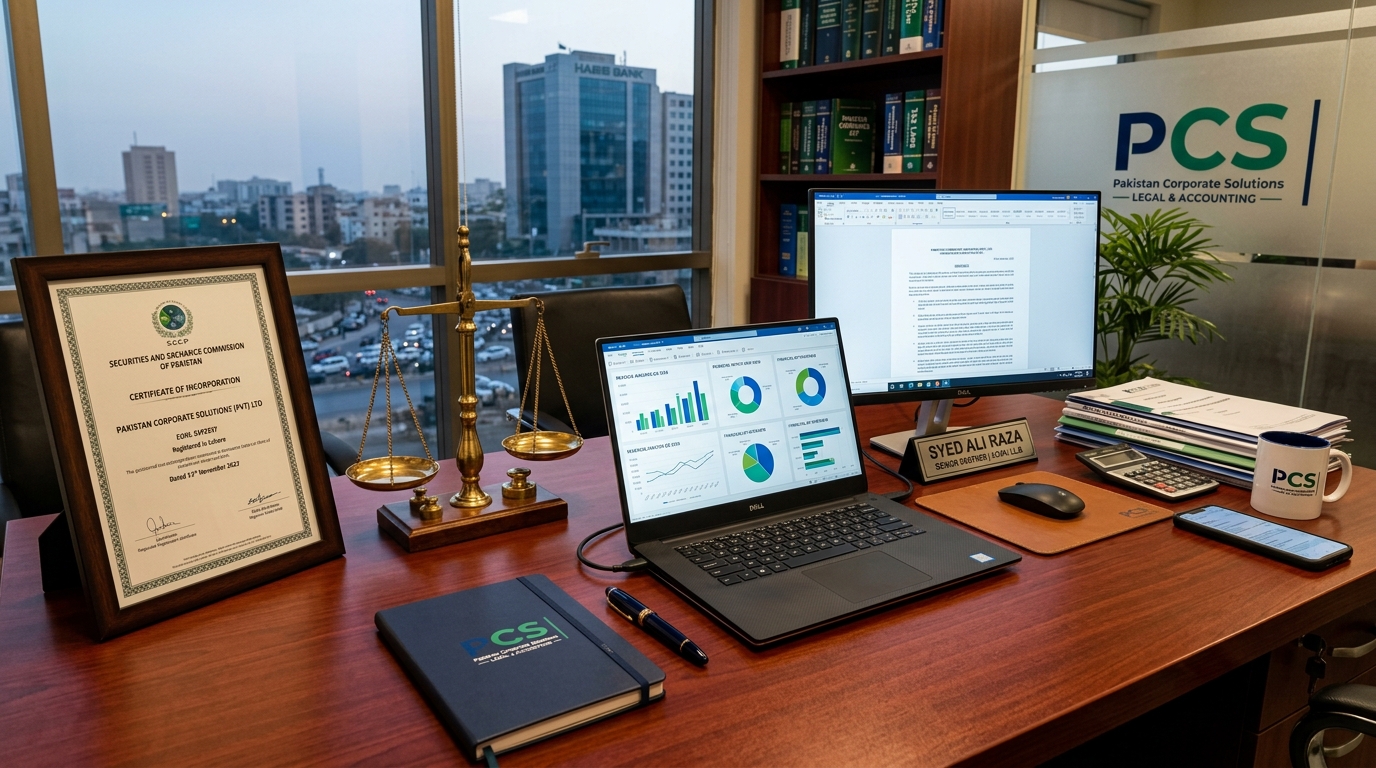
Freelancer Sole Proprietor Vs SMC-Private Limited In Pakistan: Tax Savings, PSEB & SBP Rules
Should you remain an individual freelancer or incorporate a Single Member Company (SMC-Pvt Ltd) in Pakistan? Detailed tax, legal liability, banking, and PSEB comparison for growing digital entrepreneurs.
By Syed Asad Hussain Zaidi · 9 September 2026
Legal Separation: A Sole Proprietorship offers zero corporate separation; the individual freelancer is personally liable with their personal assets for all contractual and commercial debts. An SMC-Private Limited establishes a distinct juristic entity under the Companies Act 2017.
Tax Equalization under Section 154A: Both sole proprietorships and private limited companies can claim the 0.25% concessionary export tax rate under Section 154A, provided both entities maintain active PSEB registration.
Corporate Banking Advantages: SMCs can open corporate merchant accounts, issue shares to foreign investors, access SBP specialized foreign currency credit limits, and sign international enterprise B2B service contracts that refuse to contract with unincorporated individuals.
Compliance Overhead: Incorporating an SMC requires annual SECP statutory filings (Form A, Form 19 UBO compliance, audited financial statements), whereas a Sole Proprietor only files an annual personal FBR income tax return.
[Tax Year 2026 Framework]
- Updated for FY 2026 compliance.
- Reflects current FBR and SECP statutory requirements.
The Growth Dilemma for Top-Tier Digital Exporters
Pakistani digital entrepreneurs, agency founders, and senior freelancers scaling past $3,000 to $10,000 per month face a pivotal legal decision: should they continue operating as an unincorporated Sole Proprietorship (individual business NTN), or incorporate a Single Member Company (SMC-Private Limited) with the Securities and Exchange Commission of Pakistan (SECP)?
While low-earning freelancers frequently prefer the informal simplicity of a sole proprietorship, expanding agencies managing remote developer teams, high-value US/UK client contracts, and enterprise software deployments rapidly outgrow individual registration. Legal liability, cross-border corporate credibility, dividend extraction, and regulatory banking friction necessitate a rigorous evaluation of both structures.
Detailed Comparative Analysis: Sole Proprietor vs. SMC-Pvt Ltd
| Evaluation Criterion | Sole Proprietorship (Individual NTN) | Single Member Company (SMC-Pvt Ltd) | | :--- | :--- | :--- | | Governing Statute | Income Tax Ordinance 2001 | Companies Act 2017 & Income Tax Ordinance 2001 | | Legal Personality | No separate legal entity; business equals individual | Separate juristic person with perpetual succession | | Personal Liability | Unlimited: Personal bank accounts & home exposed | Limited: Capped at paid-up share capital | | SECP Registration | Not applicable (Zero SECP involvement) | Mandatory incorporation via SECP eZoffice | | PSEB Classification | Registered as "Freelancer / Individual IT Exporter" | Registered as "IT / Software House Corporate" | | Section 154A Tax Rate | 0.25% (if PSEB compliant) or 1.0% | 0.25% (if PSEB compliant) or 1.0% | | Offshore Enterprise Contracts| Major US/EU enterprises often decline contracts | Readily accepted by Fortune 500 & enterprise clients | | Equity & Co-Founders | Cannot sell shares or issue employee stock options | Easily converted to multi-member Pvt Ltd for equity | | Annual Audit Burden | No statutory audit required for simple turnover | Mandatory audit by licensed Chartered Accountant | | Annual Compliance Cost | Minimal (FBR return fee only: ~PKR 15k - 30k) | Moderate to High (SECP + Audit + FBR: ~PKR 60k - 150k) |
Corporate Tax Implications: Drawing Funds from an SMC
A common misconception among developers is that corporate status automatically increases tax liability. Under Pakistani tax law:
Section 154A Parity: An SMC exporting 100% of its software services abroad is subject to the same 0.25% withholding tax at the commercial bank realization stage as an individual freelancer.
The Dividend Distribution Trap (Section 150): If an individual freelancer earns $50,000, pays 0.25% tax, and withdraws the remaining PKR into their personal savings account, that money is completely clean personal wealth. However, inside an SMC, profits belong to the company. When the company distributes these profits to the owner as a dividend, Section 150 imposes a dividend withholding tax (typically 15% for filers).
Optimizing Through Director Salary: To legitimately avoid the double hit of dividend taxation, the sole shareholder-director can draw a formal executive salary from the SMC. The salary is booked as an operational business expense of the company, reducing corporate taxable profit to zero. The director then pays salary tax under personal progressive brackets (or concessionary allowances if applicable).
When You MUST Transition to an SMC-Pvt Ltd
You should immediately formalize an SMC-Private Limited if your digital business meets any of the following commercial thresholds:
Hiring Full-Time Employees & Contractors: If you employ more than 3 to 5 developers, designers, or project managers, operating under a personal bank account creates massive personal tax exposure. Salaried deductions under Section 149 and provincial social security/EOBI obligations are designed for corporate employers.
Signing Master Service Agreements (MSAs) with US/EU Entities: Western corporate legal departments increasingly mandate corporate status, Professional Indemnity Insurance, and Data Protection Officer (DPO) guarantees that unincorporated individuals cannot legally provide.
Retaining Foreign Currency under SBP ESFCA Guidelines: Under SBP FE Circular No. 01, corporate IT exporters enjoy higher thresholds for retaining foreign currency in local commercial banks and issuing corporate debit cards for overseas cloud infrastructure spending (AWS, Google Cloud, Azure, OpenAI API credits).
Raising Institutional or Angel Capital: Venture capital firms, angel syndicates, and government grant programs (like Ignite or Karandaaz) cannot invest in a personal NTN; they require convertible share capital.
## TaxCalc Advisory Insights: The Bank Account Transfer Risk
When transitioning from an individual freelancer to an SMC, do NOT immediately change your payout address on Upwork or Stripe to your new company without notifying your local bank. If an inward wire arrives addressed to "Apex Digital Solutions (SMC-Pvt) Ltd" while the recipient bank account is still titled under "Ahmed Khan (Individual)", the commercial bank's AML and Forex compliance desks will immediately freeze the transfer under State Bank remittance screening protocols. Always establish your corporate bank account first, link your corporate NTN and PSEB registration, and only then update your foreign payout gateway accounts to guarantee continuous 0.25% clearing.
Frequently Asked Questions (FAQs)
1. Can a single person incorporate an SMC in Pakistan?
Yes. Under Section 47 of the Companies Act 2017, a single natural person can incorporate a Single Member Company. The sole member acts as the initial director and nominates an alternate nominee director solely in case of death or incapacity.
2. Can I use our corporate tax calculator to project SMC liabilities?
Yes. You can explore our <a href="/corporate-tax-calculator">Corporate Tax Calculator</a> and <a href="/property-wht-calculator">Property Withholding Tax Suite</a> to compare corporate tax burdens versus individual freelancer earnings.
3. Does an SMC require an office lease agreement for registration?
SECP allows incorporating an SMC using a valid home address as the registered office address for tech companies and digital consultancies, provided utility bills and proof of ownership or rental tenancy are submitted during eZoffice filing.
The SECP Incorporation Blueprint: Step-by-Step for Digital Agencies
If you decide that incorporating a Single Member Company is the right structural move, the process is completed digitally on the SECP eZoffice portal:
Phase 1: Name Reservation
Submit three proposed company names on eZoffice (e.g., NovaTech Solutions (SMC-Private) Limited).
Ensure the name does not infringe existing registered trademarks or prohibited national terms.
SECP approval is typically granted within 24 to 48 hours for a statutory fee of PKR 1,500 - 2,500.
Phase 2: Drafting Memorandum and Articles of Association (MOA & AOA)
The MOA defines the principal line of business. For IT firms, specify comprehensive clauses covering software architecture, cloud hosting, AI engineering, digital consultancy, and export of computer services.
The AOA defines internal governance, director powers, share allotments, and succession nomination under Section 47.
Phase 3: Digital Filing & Statutory Signatures
Submit Form 1 (Incorporation Application), Form 2 (Memorandum & Articles), and Form 3 (Allotment of Shares).
Secure SECP digital user ID and PIN verification for the sole member.
Upload CNIC copy, registered office address utility bills, and nominee director consent letter.
Pay the digital incorporation challan (typically PKR 3,500 - 7,000 depending on authorized capital).
SECP issues the digital Certificate of Incorporation (e-Incorporation) containing the unique Corporate Universal Identification Number (CUIN).
| Incorporation Milestone | Required Documentation | Statutory Timeline | | :--- | :--- | :--- | | Name Reservation | Proposed corporate titles + Business objective | 1 - 2 Business Days | | eZoffice Application | Form 1, Form 2, Nominee Director Consent | 2 - 4 Business Days | | Corporate NTN Issuance | Automated link between SECP & FBR Iris | Immediate upon Incorporation | | Corporate Bank Account | Certified MOA/AOA, Certificate of Inc, Form 1 | 7 - 14 Business Days | | PSEB Corporate Registration | Corporate NTN, Bank Letter, Founding Profiles | 5 - 10 Business Days |
Strategic Cash Extraction: Salary vs. Dividend vs. Expense Reimbursement
The greatest tactical hurdle for an SMC owner is extracting profits legally with zero unnecessary tax leakages:
Method 1: Executive Director Salary (Recommended)
The company designates the sole director as Chief Technology Officer (CTO) or Chief Executive Officer (CEO) with a documented employment contract and monthly payroll.
Tax Benefit: The salary is a 100% tax-deductible operating expense for the SMC under Section 20. The SMC pays zero corporate tax on that amount.
Tax Withholding: The SMC deducts salary tax at source under Section 149. Because the first PKR 600,000 is 0% and subsequent slabs are progressive, an optimized salary structure results in very low blended taxation.
Method 2: Expense Reimbursements
legitimate business expenditures incurred by the founder (home office internet, high-speed fiber lines, laptop hardware, software subscriptions, client entertainment, cloud server fees) are paid directly by the company or reimbursed to the founder against authentic tax invoices.
Tax Benefit: Reimbursed legitimate business expenses are not considered taxable personal income under Section 11.
Method 3: Dividend Distribution (Use Sparingly)
Any post-tax profits left in the corporate bank account can be distributed as a formal dividend.
Tax Treatment: Under Section 150, the company must withhold 15% dividend tax for active filers, which serves as a final tax for the recipient shareholder.
The SECP Incorporation Blueprint: Step-by-Step for Digital Agencies
If you decide that incorporating a Single Member Company is the right structural move, the process is completed digitally on the SECP eZoffice portal:
Phase 1: Name Reservation
Submit three proposed company names on eZoffice (e.g., NovaTech Solutions (SMC-Private) Limited).
Ensure the name does not infringe existing registered trademarks or prohibited national terms.
SECP approval is typically granted within 24 to 48 hours for a statutory fee of PKR 1,500 - 2,500.
Phase 2: Drafting Memorandum and Articles of Association (MOA & AOA)
The MOA defines the principal line of business. For IT firms, specify comprehensive clauses covering software architecture, cloud hosting, AI engineering, digital consultancy, and export of computer services.
The AOA defines internal governance, director powers, share allotments, and succession nomination under Section 47.
Phase 3: Digital Filing & Statutory Signatures
Submit Form 1 (Incorporation Application), Form 2 (Memorandum & Articles), and Form 3 (Allotment of Shares).
Secure SECP digital user ID and PIN verification for the sole member.
Upload CNIC copy, registered office address utility bills, and nominee director consent letter.
Pay the digital incorporation challan (typically PKR 3,500 - 7,000 depending on authorized capital).
SECP issues the digital Certificate of Incorporation (e-Incorporation) containing the unique Corporate Universal Identification Number (CUIN).
| Incorporation Milestone | Required Documentation | Statutory Timeline | | :--- | :--- | :--- | | Name Reservation | Proposed corporate titles + Business objective | 1 - 2 Business Days | | eZoffice Application | Form 1, Form 2, Nominee Director Consent | 2 - 4 Business Days | | Corporate NTN Issuance | Automated link between SECP & FBR Iris | Immediate upon Incorporation | | Corporate Bank Account | Certified MOA/AOA, Certificate of Inc, Form 1 | 7 - 14 Business Days | | PSEB Corporate Registration | Corporate NTN, Bank Letter, Founding Profiles | 5 - 10 Business Days |
Strategic Cash Extraction: Salary vs. Dividend vs. Expense Reimbursement
The greatest tactical hurdle for an SMC owner is extracting profits legally with zero unnecessary tax leakages:
Method 1: Executive Director Salary (Recommended)
The company designates the sole director as Chief Technology Officer (CTO) or Chief Executive Officer (CEO) with a documented employment contract and monthly payroll.
Tax Benefit: The salary is a 100% tax-deductible operating expense for the SMC under Section 20. The SMC pays zero corporate tax on that amount.
Tax Withholding: The SMC deducts salary tax at source under Section 149. Because the first PKR 600,000 is 0% and subsequent slabs are progressive, an optimized salary structure results in very low blended taxation.
Method 2: Expense Reimbursements
legitimate business expenditures incurred by the founder (home office internet, high-speed fiber lines, laptop hardware, software subscriptions, client entertainment, cloud server fees) are paid directly by the company or reimbursed to the founder against authentic tax invoices.
Tax Benefit: Reimbursed legitimate business expenses are not considered taxable personal income under Section 11.
Method 3: Dividend Distribution (Use Sparingly)
Any post-tax profits left in the corporate bank account can be distributed as a formal dividend.
Tax Treatment: Under Section 150, the company must withhold 15% dividend tax for active filers, which serves as a final tax for the recipient shareholder.
Legal & Statutory Notice: The information provided in this publication is for general educational, academic, and statutory informational purposes only under the relevant laws of Pakistan (including the Income Tax Ordinance, 2001, the Companies Act, 2017, and the Trade Marks Ordinance, 2001). This content does not constitute formal legal, financial, or tax advice. For specific assessments, consult a licensed Advocate or qualified tax professional.
 TaxCalc.pk
FY 2026-27
TaxCalc.pk
FY 2026-27