AOP Vs Private Limited Company In Pakistan
Compare an AOP and a private limited company in Pakistan by liability, ownership, tax treatment and compliance before choosing your business structure.
By Syed Asad Hussain Zaidi · 12 October 2026
Author Note / Last Updated: Updated October 2026 by Syed Asad Hussain Zaidi | Advocate High Court & Tax Consultant
[Statutory Legal Framework: Business Structures in Pakistan]
- Partnership Act, 1932: Section 4 (definition of partnership and firm); Section 25 (joint and several personal liability of partners for acts of the firm).
- Companies Act, 2017: Section 16 (incorporation of companies); Section 49 (limited liability of shareholders); statutory registers, share transfers, and SECP corporate governance.
- Income Tax Ordinance, 2001: Section 80(1)(a) & Section 92 (taxation of an Association of Persons as a separate taxable entity); Section 150 (dividend taxation and withholding under First Schedule, Part III, Division I); Section 154A (export proceeds taxation).
An ordinary partnership taxed as an Association of Persons (AOP) may suit owners who want to manage a business directly together. A private limited company offers separate legal identity and limited shareholder liability, with more corporate administration. The better choice depends on risk, ownership plans, and total tax cost.
Choosing a business structure affects far more than registration paperwork. It shapes who can commit the business to a contract, how owners receive money, how profits are taxed, and what happens when an owner leaves or brings in an investor.
This guide compares an ordinary partnership firm assessed as an Association of Persons (AOP) with a private company limited by shares. (For details on distinguishing a partnership deed from an AOP tax certificate, consult our companion guide on Partnership Firm vs AOP in Pakistan, as well as our business structures overview). Other AOP arrangements, non-profit entities, and limited liability partnerships (LLPs) require separate consideration.
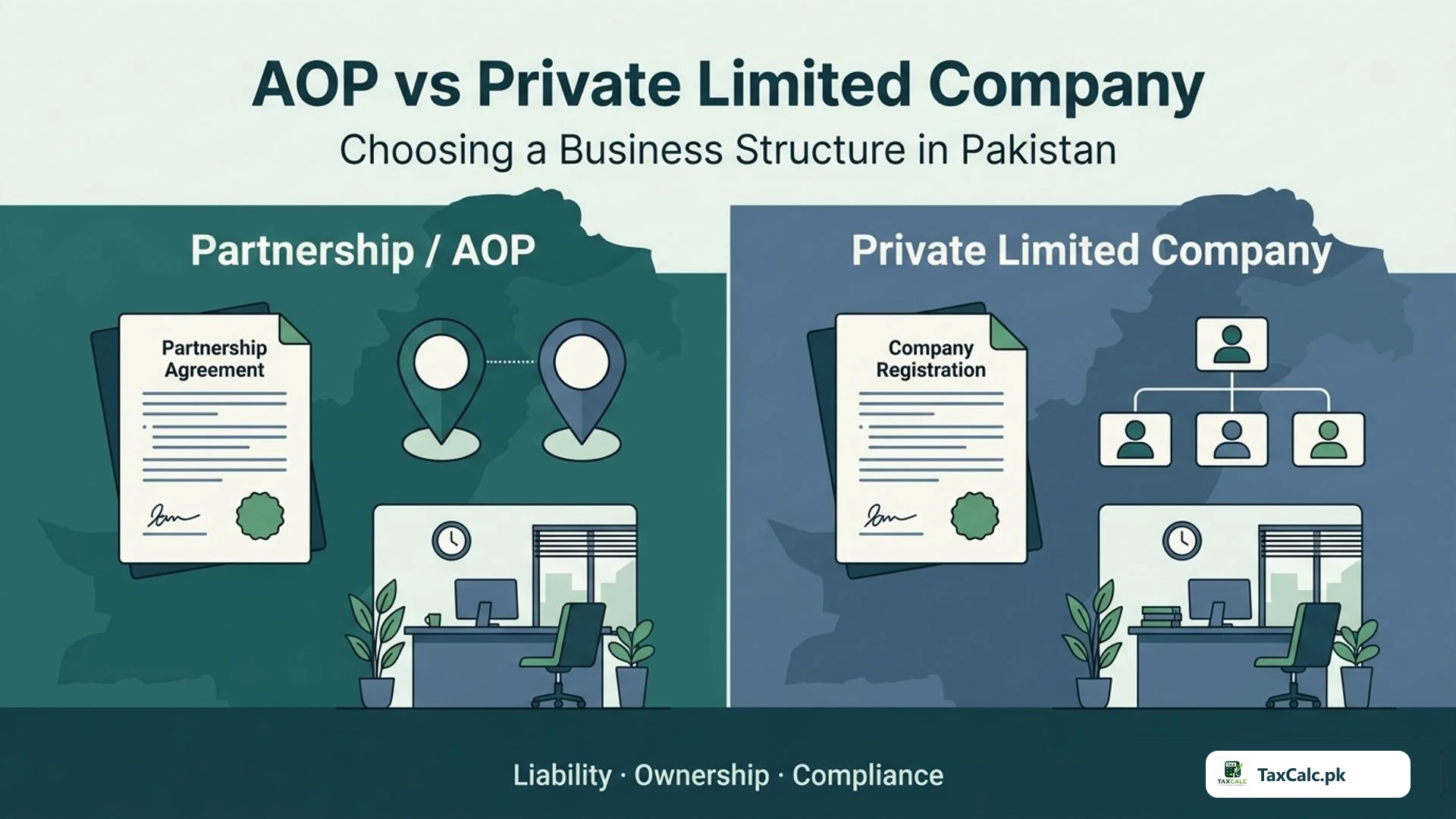
AOP vs Private Limited Company: Main Differences
| Question | Ordinary partnership / AOP | Private company limited by shares | |---|---|---| | What is the ownership arrangement? | Partners operate under their contractual partnership agreement | Shareholders own shares in an incorporated company | | What governs the structure? | Partnership Act, 1932 and the partnership deed | Companies Act, 2017, Memorandum (MOA) and Articles of Association (AOA) | | How is it registered? | Firm registration through the relevant Registrar of Firms; income-tax registration with FBR | Corporate incorporation through SECP; income-tax registration with FBR | | What is the liability position? | Partners are jointly and severally personally liable for firm obligations | Shareholder liability is generally limited to unpaid amounts on their shares | | What records guide ownership decisions? | Partnership deed and recorded supplemental deeds | Articles, statutory registers, share certificates, and board/general meeting minutes | | What ongoing administration applies? | Partnership records and applicable tax obligations | Corporate statutory registers, annual returns to SECP, financial statements, and tax returns |
These distinctions follow the partnership framework, SECP’s corporate guidance, and the separate regulatory functions of the relevant authorities.
1. Compare Personal Liability Before Registration Costs
Under Section 25 of the Partnership Act, 1932, partners are jointly and severally liable for all acts of the firm done while they are partners.
This matters when a business borrows, purchases inventory on trade credit, or signs commercial contracts carrying substantial liabilities. An internal partnership agreement dividing responsibility between partners (e.g., agreeing that Partner A handles 70% of debts) does not, by itself, bind outside creditors or eliminate a creditor’s statutory right to claim 100% against any single partner’s personal assets.
A company limited by shares provides a fundamentally different starting point: the company possesses its own independent legal personality (separate corporate personality), and members’ liability is strictly limited to any unpaid amount on the shares they subscribed. Personal assets of shareholders remain insulated from corporate trade debts.
However, business owners should review any proposed personal guarantees separately. Banks, institutional lenders, and major commercial landlords in Pakistan routinely demand personal director guarantees before issuing credit or leasing property to newly formed private companies. Before signing borrowing or supplier contracts, identify clearly whether the obligation belongs to the business entity, an individual owner, or both.
2. Decide How Ownership and Management Will Work
For an ordinary partnership:
- Discuss and document who has bank signing powers, who can enter into binding supply contracts, and who must authorize major capital expenditure.
- Explicitly record how net profits and losses are divided, what happens upon retirement, death, or insolvency of a partner, and how disputes will be settled.
For a private limited company:
- Distinguish share ownership from managerial authority. Being a shareholder does not make every business decision an informal personal decision. The company acts through its Board of Directors and designated Chief Executive Officer (CEO).
- The Companies Act, 2017 provides formal procedures for share transfers, board approvals, and further issues of share capital. Private-company share transfers are subject to restrictions contained in the Articles of Association (pre-emption rights); bringing in an external angel investor or venture capital firm requires formal board resolutions, Form 26 allotments, or Form 35 transfer filings—not merely agreeing on a percentage verbally over a handshake.
Under SECP regulations, two or more persons may form an ordinary private limited company. A single founder can establish a Single-Member Company (SMC-Private Limited), which allows corporate limited liability for solo entrepreneurs.
Before choosing either vehicle, write down:
- Who owns the business and who manages daily operations.
- Which strategic decisions require unanimous consent versus simple majority.
- How additional working capital and expansion funds will be injected.
- How an owner can exit, and how their interest or shares will be valued.
Answering these four questions early often reveals structural mismatches before filing fees and registration procedures begin.
3. Compare the Full Tax Position
Company registration does not guarantee that the business will pay less tax.
Under Section 92 of the Income Tax Ordinance, 2001, an Association of Persons (AOP) is assessed as a separate taxable entity. The AOP pays tax on its taxable income under the standard non-salaried business tax rates (Division I, Part I of the First Schedule). Once the AOP has paid its due income tax, the share of profit received by an individual partner is generally exempt from further tax in the partner's hands, subject to the inclusion of that share for rate-purposes on their other taxable income.
In contrast, a private limited company operates under a two-tier tax structure:
- Corporate Income Tax: The company pays corporate tax (currently 29% plus applicable super tax under Section 4C) on its net taxable profit. Small companies meeting specific turnover and employee criteria under Section 2(59A) may qualify for lower progressive corporate rates.
- Dividend Withholding Tax: When retained corporate profits are distributed to shareholders as dividends, tax is withheld under Section 150 (referencing the First Schedule, Part III, Division I) at 15% for filers (or higher rates for non-filers).
A comprehensive financial comparison should model:
| Item to model | Why it matters | |---|---| | Business income and deductible expenses | Establishes the net taxable profit under accounting and tax standards | | Applicable tax regime | Normal tax regime (NTR) vs minimum tax (Section 113) vs final withholding taxes | | Profits retained in the business | Determines cash reserves available for reinvestment without dividend friction | | Payments to owners | Salaries, director remuneration, advisory fees, and dividends each carry distinct tax treatments | | Withholding taxes deducted | Checking whether advance tax deducted at source is adjustable against final corporate or AOP liability | | Accounting and compliance costs | Bookkeeping, corporate secretarial filings, statutory audit fees, and professional tax fees affect total operational cost |
Use the exact same commercial figures and revenue projections when modeling both structures. A comparison based on differing profit or cash withdrawal assumptions will produce misleading conclusions.
For IT exporters and freelancers, assess Section 154A eligibility independently. Incorporating a private company does not automatically confer preferential tax treatment or exemption status; compliance with State Bank of Pakistan (SBP) foreign remittance reporting (PRC/e-PRC) and relevant registration remains essential regardless of corporate form.
4. Budget for Ongoing Administration
A private limited company requires consistent corporate governance following incorporation. Depending on company size and turnover, statutory duties include:
- Maintaining statutory registers (Register of Members, Register of Directors, Register of Mortgages/Charges).
- Convening Annual General Meetings (AGM) and filing annual returns (such as Form A or Form 19 for Ultimate Beneficial Ownership where applicable).
- Preparing formal annual financial statements and, where statutory audit thresholds apply, appointing a licensed chartered accountant or cost and management accountant.
- Filing statutory forms with SECP whenever directors change (Form 29), capital increases (Form 7), or shareholdings transfer (Form 26 / Form 35).
SECP provides exemptions and simplified reporting for small companies, so obligations vary according to company classification. Verify precise filing requirements against the current SECP Companies (General Provisions and Forms) Regulations.
An ordinary partnership also demands orderly record-keeping. Amendments to partners, profit shares, business addresses, or firm name require executing an amended partnership deed and updating the provincial Registrar of Firms (Form V / Form VIII procedures).
Before deciding, request a realistic annual compliance budget from your tax and legal advisor that details bookkeeping, annual tax return filings, SECP corporate filings, and statutory audit obligations.
A Practical Way to Choose
Consider two founders starting a commercial or consulting venture:
- When an ordinary partnership / AOP fits: If both founders will actively work in daily operations, ownership will remain stable between them, capital requirements are modest, and contractual exposure is manageable, an ordinary registered partnership taxed as an AOP provides straightforward governance without corporate secretarial overhead.
- When a private limited company fits: If the enterprise seeks angel or venture capital investment, plans to issue stock options (ESOPs), anticipates significant trade debt, or enters substantial multi-year commercial contracts, an incorporated company provides the necessary legal separation and scalability.
Prepare a short operational model covering expected first-year revenue, net profit, financing needs, owner drawings, and investor plans. Review the legal exposure and the net tax computation simultaneously.
The next useful step is understanding the regulatory bodies that oversee each stage. TaxCalc.pk’s upcoming guide on Registrar of Firms vs SECP vs FBR breaks down the distinct authority, jurisdiction, and procedures of each institution.
Legal & Statutory Notice: The information provided in this publication is for general educational, academic, and statutory informational purposes only under the relevant laws of Pakistan (including the Income Tax Ordinance, 2001, the Companies Act, 2017, and the Trade Marks Ordinance, 2001). This content does not constitute formal legal, financial, or tax advice. For specific assessments, consult a licensed Advocate or qualified tax professional.