>
 TaxCalc.pk
FY 2026-27
Understand FBR Circular 05 of 2022, Section 111(4), the remittance threshold, PRC evidence and why overseas receipts are not automatically tax-free.
By Syed Asad Hussain Zaidi · 19 October 2026
Author Note / Last Updated: Updated October 2026 by Syed Asad Hussain Zaidi | Advocate High Court & Tax Consultant (LLM, Member Lahore Tax Bar Association)
[Statutory Legal Framework: Foreign Remittances & Section 111(4) in Pakistan]
- Income Tax Ordinance, 2001 — Section 111(4): Excludes qualifying foreign exchange remitted from outside Pakistan through scheduled banking channels and encashed into Pakistani rupees from unexplained income treatment under Section 111(1), capped at a statutory threshold of Rs. 5 million in a tax year (Finance Act, 2021).
- Income Tax Ordinance, 2001 — Section 111(1): Empowers the Commissioner to treat unexplained cash credits, investments, money, or expenditures as deemed income chargeable under "Income from Other Sources" where the taxpayer fails to offer a satisfactory explanation regarding nature and source.
- Income Tax Ordinance, 2001 — Section 154A: Dedicated export tax regime for IT and IT-enabled services proceeds realised through banking channels, distinct from general foreign remittances.
- FBR Circular No. 05 of 2022 (Operations): Dated 30 August 2021 (titled Foreign Remittances — Exemption); clarifies that remittances received via Money Services Businesses (MSBs), Exchange Companies, and Money Transfer Operators (MTOs such as Western Union, MoneyGram, and Ria) satisfy the banking channel condition under Section 111(4) when backed by a scheduled bank encashment certificate.
- State Bank of Pakistan (SBP) Foreign Exchange Regulations: SBP ePRC framework and regulatory circulars governing the issuance of Proceeds Realization Certificates (PRCs) by authorized dealers for foreign exchange surrenders and encashments.
Money received from abroad is not automatically tax-free. Section 111(4) of the Income Tax Ordinance, 2001 provides conditional protection against unexplained-income treatment—not a blanket, permanent tax exemption for every foreign receipt.
FBR Circular No. 05 of 2022 clarifies how qualifying foreign remittances routed through exchange companies and global money-transfer operators (MTOs) satisfy the statutory banking-channel requirements.
For overseas Pakistanis, resident families receiving household support, digital freelancers, and international consultants, understanding this legal distinction is crucial. Evidence that funds arrived from abroad answers one question: where did the money come from? Whether that money represents taxable business revenue, capital receipts, or a non-taxable personal gift answers another question entirely.
The circular issued by the Federal Board of Revenue (FBR) is titled “Foreign Remittances — Exemption.” Although officially indexed as Circular No. 05 of 2022 (Operations), it was signed and issued on 30 August 2021.
The circular resolved protracted departmental disputes regarding foreign remittances received through Money Services Businesses (MSBs), Exchange Companies, and Money Transfer Operators (MTOs)—most notably global services such as Western Union, MoneyGram, and Ria.
Historically, field tax officers frequently issued audit notices under Section 111(1), contending that funds routed through money transfer operators did not constitute a direct overseas bank-to-bank SWIFT wire transfer and therefore failed the strict "banking channel" condition of Section 111(4).
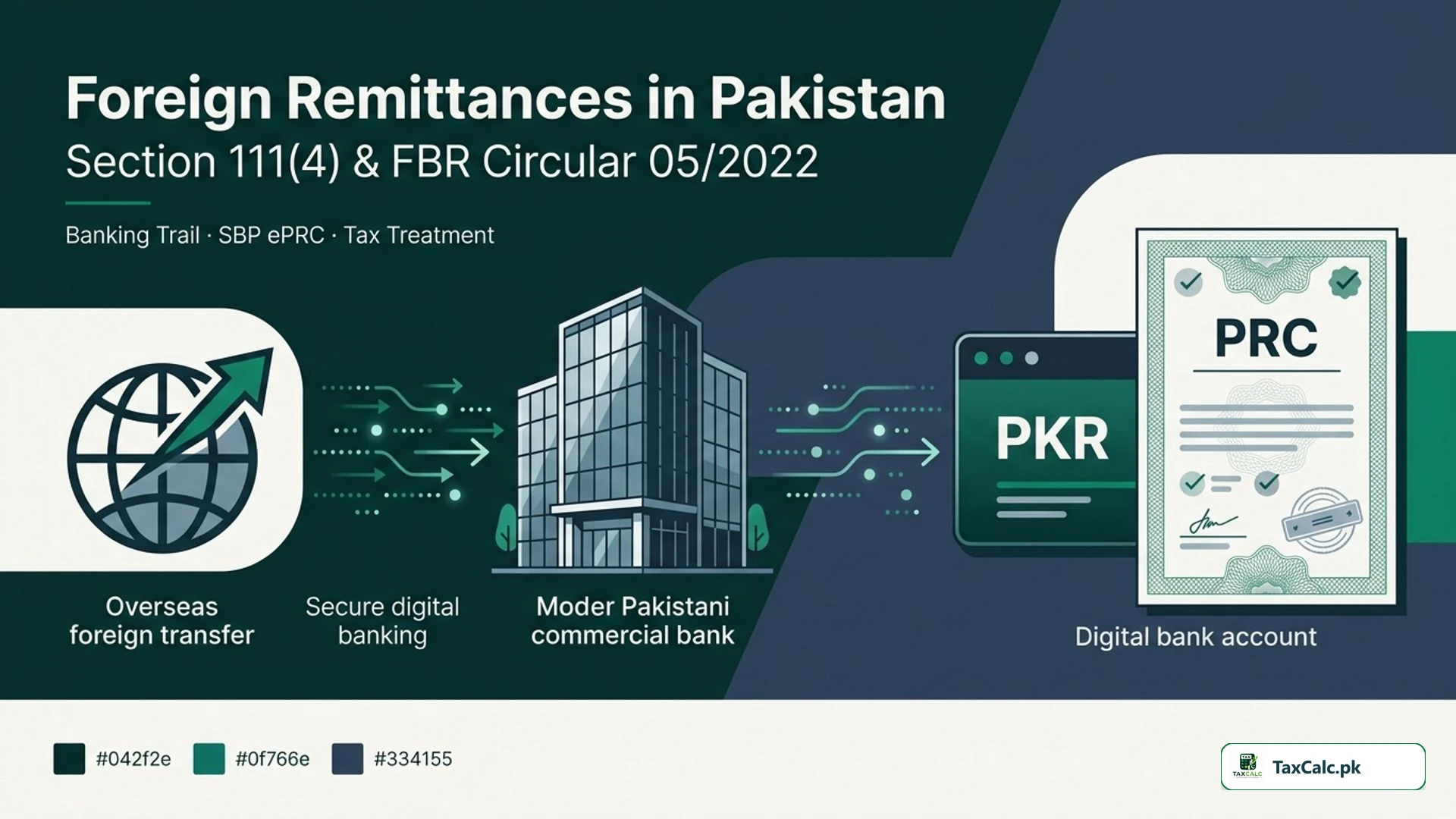
[Overseas Sender (Foreign Currency)]
│ ▼ [Global MTO / Exchange Company] (Western Union, MoneyGram, Ria) │ (International Banking Arrangements) ▼ [Pakistani Scheduled Bank / Authorized Dealer] │ Surrenders / Encashes FX │ ▼ [Beneficiary Rupee Account / Cash] + [Official Bank Encashment / ePRC]
The circular records the State Bank of Pakistan's (SBP) technical explanation of the underlying foreign exchange mechanism:
Based on SBP's clarification, the FBR directed field formations to adopt a purposive and lenient interpretation of the banking-channel condition for genuine transactions supported by bank encashment certificates. Crucially, this administrative concession recognizes the valid banking mechanism—it does not relieve the recipient of establishing that the transaction meets all statutory conditions.
Under Section 111(4)(a) of the Income Tax Ordinance, 2001 (as amended by the Finance Act, 2021), foreign exchange remitted from outside Pakistan is excluded from the unexplained income provisions of Section 111(1), subject to a statutory cap of Rs. 5 million in a tax year.
To qualify for this safe-harbor protection against unexplained-income additions, five cumulative conditions must be satisfied:
| Statutory Condition | What the Recipient Must Establish | Common Pitfalls to Avoid | |---|---|---| | Overseas Origin | The funds genuinely originated outside Pakistan from a bona fide foreign source. | Cash carried across borders or round-tripped local funds fail this test. | | Banking Channel | Transferred via scheduled banks, SWIFT wires, or qualifying MTOs under SBP arrangements. | Informal hundi/hawala, third-party domestic cash transfers, or unofficial peer-to-peer swaps. | | Rupee Encashment | A Pakistani scheduled bank encashed or realised the foreign exchange into Pakistani rupees (PKR). | Holding undocumented cash foreign currency notes at home. | | Bank Certificate | An authentic Proceeds Realization Certificate (PRC/ePRC) issued by the encashing bank. | Relying solely on an MTO counter receipt without the formal bank encashment certificate. | | Annual Limit | The cumulative foreign remittances claimed under Section 111(4) do not exceed Rs. 5,000,000 in the relevant tax year. | Assuming the Rs. 5 million limit resets for each individual bank transfer or distinct bank account. |
[!IMPORTANT]
The statutory limit applies per taxpayer per tax year (1st July through 30th June), not per bank transaction, sender, or bank branch.
No. A common and expensive misconception among taxpayers is assuming that any money arriving from abroad with a bank stamp is automatically exempt from all income tax.
The title of FBR Circular 05 of 2022 uses the administrative label “Exemption,” but substantive law is governed by the statute itself. Section 111(4) is an exclusion from unexplained income and asset assessments (Section 111)—it is not an exemption clause in the Second Schedule to the Income Tax Ordinance.
The law establishes a fundamental two-step legal distinction:
                  ┌──────────────────────────────────────────────┐
│ 1. Explaining the Money (Section 111)        │ │ "Did the funds arrive from a verifiable,     │ │  legitimate overseas banking channel?"       │ └──────────────────────┬───────────────────────┘ │ YES (PRC / ePRC Verified) ▼ ┌──────────────────────────────────────────────┐ │ 2. Characterising the Receipt (Charging Sec) │ │ "What is the commercial or personal nature   │ │  of these remitted funds?"                   │ └──────────────────────┬───────────────────────┘ │ ┌───────────────────────────────┼───────────────────────────────┐ ▼                               ▼                               ▼ [Personal / Family Support]    [Export of Services / Freelancing]   [Commercial / Trading Profit] Non-taxable capital receipt    Subject to Section 154A / 100SZ      Chargeable under Business Income
A bank encashment certificate verifies how the money entered Pakistan; it does not convert taxable service income into tax-free remittances.
Freelancers, software engineers, and digital agencies often receive client payments through Wise, Payoneer, Upwork, Fiverr, or direct international wire transfers.
A payment received from an overseas client for web development, design, consulting, or remote employment is revenue from the sale of services. Calling it a "foreign remittance" merely describes its physical movement into a Pakistani bank account—it does not change its character as business or professional earnings.
Freelancer Client Fee ≠ Family RemittanceIf a freelancer attempts to claim client fees as "home remittances" under Section 111(4) to bypass income tax returns:
[!TIP]
Freelancers and IT consultants should always instruct their bank to realise incoming client payments under the correct SBP Export Purpose Code and retain customer contracts, invoices, and platform payment summaries alongside their ePRCs. For accurate liability calculations, review our Freelancer Tax Calculator.
Yes. FBR Circular No. 05 of 2022 specifically addressed and settled this question.
Where an overseas Pakistani or family member remits funds through an international money transfer company, the transfer qualifies under Section 111(4) provided the domestic recipient can produce the scheduled bank's encashment certificate demonstrating that:
The circular does not protect:
The complete paper and digital trail linking the foreign sender to the Pakistani scheduled bank remains mandatory.
Taxpayers receiving foreign funds should maintain an organized transaction audit file for a minimum of six years:
| Document | Primary Function | Key Details to Check | |---|---|---| | Proceeds Realization Certificate (PRC / ePRC) | Official statutory proof of foreign exchange receipt and rupee encashment in Pakistan. | Beneficiary name, CNIC/NTN, foreign currency amount, conversion exchange rate, rupee total, SBP purpose code. | | Bank Statement | Establishes the corresponding ledger credit entry in the recipient's Pakistani bank account. | Date of credit, transaction description, matching rupee figure with the ePRC. | | Transfer Receipt / SWIFT MT103 / Payment Advice | Connects the overseas remitter's payment order to the receiving bank's transaction. | Sender name, originating foreign bank/MTO, reference tracking number (MTCN/PIN). | | Sender & Beneficiary Relationship Proof | Proves the family connection or personal status of the overseas sender. | CNIC, NICOP, passport, proof of foreign residency/employment, family registration certificate (FRC) for substantial gifts. | | Underlying Transaction Evidence | Documents the genuine legal nature of the receipt. | Invoices, service contracts, loan agreements, gift deeds, inheritance deeds, or evidence of overseas asset sales. | | Annual Wealth Reconciliation (Wealth Statement) | Reconciles incoming remittances with year-end assets, bank balances, and household consumption. | Filed in Form 116 alongside the annual income tax return. |
The State Bank of Pakistan's electronic PRC (ePRC) system allows beneficiaries to verify and download their certificate directly from commercial bank portals. Ensure that the sender and beneficiary details, amounts, and stated purposes match before relying on them during tax filings.
Exceeding the Rs. 5 million annual threshold under Section 111(4) does not automatically make the entire remittance taxable.
It simply means that the statutory safe-harbor immunity under Section 111(4) no longer prevents the tax department from inquiring into the genuine source of the funds. Once the remittance exceeds Rs. 5 million in a tax year:
[!WARNING]
If a taxpayer receives Rs. 15 million from abroad, cannot show who the remitter was, or relies on an unrelated foreign third party to route local unexplained funds, the entire amount above the statutory safe harbor can be treated as unexplained deemed income under Section 111(1) and taxed at standard rates.
If you receive a notice under Section 111(1), Section 122, or Section 176 from the FBR regarding foreign remittances:
- Name and overseas country of remitter - Foreign currency denomination and amount - Interbank exchange rate applied - Net PKR credited - Bank reference number and PRC / ePRC number
✓ Verify all foreign transfers are routed through SBP-authorized banks or licensed MTOs.
✓ Download and archive the official ePRC for every single incoming international credit. ✓ Separate family maintenance transfers from freelance IT / export service proceeds. ✓ Report foreign remittances accurately under the "Exempt Income / Remittances" tab in your annual wealth reconciliation. ✓ For remittances exceeding Rs. 5 million, maintain documentation establishing the overseas sender's source of funds.
If you are a freelancer or business owner receiving international payments, consult our Income Tax Return Filing Services and verify your withholding and export eligibility to ensure full regulatory compliance.
Legal & Statutory Notice: The information provided in this publication is for general educational, academic, and statutory informational purposes only under the relevant laws of Pakistan (including the Income Tax Ordinance, 2001, the Companies Act, 2017, and the Trade Marks Ordinance, 2001). This content does not constitute formal legal, financial, or tax advice. For specific assessments, consult a licensed Advocate or qualified tax professional.