>
 TaxCalc.pkFY 2026-27
Understand PRCs, e-PRCs and bank purpose codes for freelance export payments in Pakistan, including how to reconcile receipts and query incorrect records.
By Syed Asad Hussain Zaidi · 3 October 2026
✓ Verified for Tax Year 2026-27 (Finance Act 2026) · High Court Advocate Review
Calculate 0.25% vs 1% final tax regime, PSEB registration savings, and PRC compliance for IT exports.
Author Note / Last Updated: Updated October 2026 by Syed Asad Hussain Zaidi | Advocate High Court & Professional Tax Consultant. Reviewed by Syed Asad Hussain Zaidi, Advocate High Court & Tax Consultant.
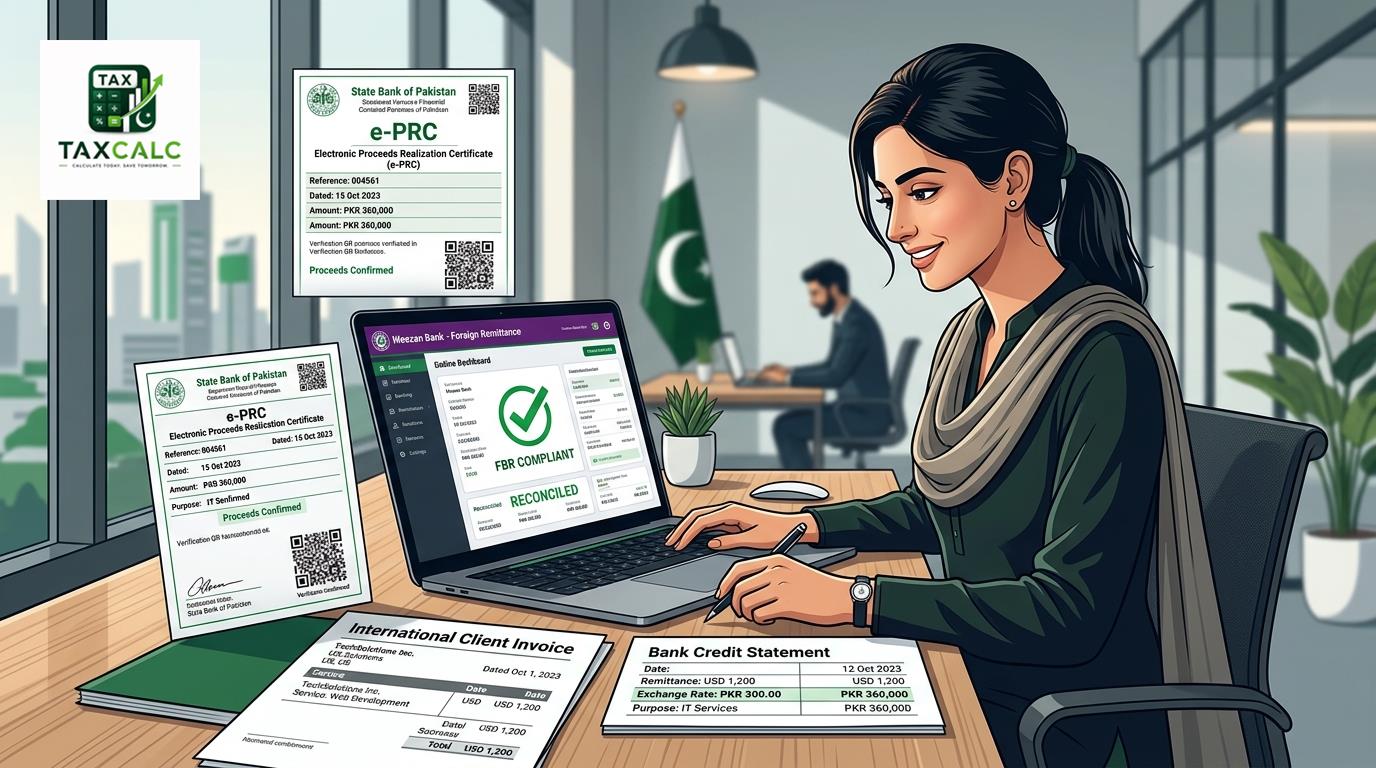
A Proceeds Realization Certificate, or PRC, is an official banking instrument that documents foreign currency remittances received from overseas and converted into Pakistani Rupees (PKR). Its verifiable digital iteration is known as an electronic Proceeds Realization Certificate (e-PRC).
For digital service exporters, independent software engineers, and online creators, this record provides vital documentary substantiation for foreign receipts. However, having an e-PRC in hand does not independently establish eligibility for the concessionary 0.25% export tax rate or statutory final-tax treatment under the Income Tax Ordinance, 2001.
Before using the TaxCalc.pk Freelancer & IT Export Tax Calculator, taxpayers must methodically connect each incoming foreign payment to its client invoice, platform transaction log, bank credit advice, and withholding tax deduction. That end-to-end reconciliation explains discrepancies between gross client billings and net bank credits, safeguarding your business from FBR non-compliance notices.
According to regulatory guidelines issued by the State Bank of Pakistan (SBP), a Proceeds Realization Certificate serves as conclusive evidence that foreign exchange was received from abroad through authorized banking channels and realized in Pakistan in PKR. Such inward remittances encompass:
SBP’s standardized electronic architecture provides individually identifiable e-PRCs and comprehensive statements of PRCs featuring unique identification numbers and QR verification codes accessible through authorized commercial banks.
| Stage | Entity / Role | Documentary Deliverable | Key Data Captured | | :--- | :--- | :--- | :--- | | 1. Origin | Overseas Client / Platform Payout | Remittance Advice / Invoice | Foreign currency bill details and remitter identity. | | 2. Transit | International Wire / Intermediary Bank | SWIFT MT103 Message | Intermediary correspondent bank charges and routing logs. | | 3. Realization | Authorized Dealer Commercial Bank (PK) | Dual Certification | Cleared in Pakistan under SBP FX reporting system. | | Deliverable A | Bank Credit Advice | Operational bank voucher | Net PKR credited, realized exchange rate, domestic deductions. | | Deliverable B | SBP e-PRC | Official regulatory certificate | Gross foreign amount, realized PKR base, and statutory SBP purpose code. |
The existence of an e-PRC confirms that money entered Pakistan legally through banking channels. However, it does not establish the legal reason why the money was transferred.
To satisfy statutory audits by the Federal Board of Revenue (FBR), freelancers must maintain the e-PRC alongside:
Together, these contemporaneous records substantiate the commercial reality behind every credit entry in your bank statement.
No. An e-PRC and a Tax Deduction Certificate (CPR / Section 154A Certificate) serve fundamentally different legal functions:
Do not assume that withholding tax was deducted merely because an e-PRC was generated. Authorized dealers may credit funds without withholding if misclassified as personal remittances, or withhold at incorrect rates if registration records are missing. You must inspect the bank’s deduction advice separately and cross-reference it with your gross foreign receipt.
A purpose code is a standardized alphanumeric classification assigned by authorized dealers to report cross-border transactions to the State Bank of Pakistan's Foreign Exchange Operations Department.
The purpose code assigned to your inward remittance determines how the central bank and the FBR interpret the underlying economic activity:
| Purpose Code Category | SBP Code & Service Name | Tax Eligibility | Regulatory Consequence | | :--- | :--- | :--- | :--- | | Qualifying IT Service Codes | 9181: Software Development<br>9182: IT Consulting & System Audit<br>9183: Call Centres & BPO Services<br>9184: Data Processing & Hosting | Eligible for Section 154A Concessionary Regime | Recognized by PSEB and FBR Iris 2.0; qualifies for 0.25% final tax rate. | | Non-Qualifying Purpose Codes | 9111: Workers' Family Remittances<br>9185: General Business Services<br>9999: Unclassified Personal Funds | Ineligible for 0.25% Final Tax Rate | Excluded from Section 154A IT concession; exposed to regular audit or standard progressive tax rates. |
The State Bank of Pakistan has repeatedly issued regulatory circulars highlighting instances where commercial banks incorrectly categorized freelance IT receipts as personal or family remittances. SBP directives mandate that authorized dealers classify all receipts under the precise service codes reflecting the actual economic service performed.
Crucial Rule: A payment received for software development, copywriting, digital marketing, or graphic design must never be reported as family support or unclassified gift remittance simply because it landed in a personal savings account. Misdeclaring export proceeds as personal remittances creates severe legal liabilities under the Foreign Exchange Regulation Act, 1947 and exposes the taxpayer to unexplained income inquiries under Section 111 of the Income Tax Ordinance, 2001.
Under SBP’s EPD Circular Letter No. 06 of 2026, commercial banks must obtain a signed declaration and customer profile from IT exporters and freelancers detailing the scope of their overseas services. Banks use this standing declaration to map incoming wires to the appropriate service category and purpose code.
However, account classifications should not be applied blindly:
Reconciling export proceeds requires connecting the gross amount billed on your client invoice to the exact PKR balance received in your account.
| Transaction Record | Critical Data Points to Verify | Potential Discrepancy | | :--- | :--- | :--- | | Client Invoice | Billable currency (USD/EUR/GBP), gross amount, and service scope | Contract modifications or client-side tax withholdings | | Platform Statement | Gross earnings, platform service fees (Upwork 10%, Fiverr 20%), withdrawal fee | Net withdrawal differs substantially from gross billing | | Intermediary Wire Receipt | Correspondent bank routing charges ($15–$35 SWIFT fees) | Missing amounts deducted during international transit | | Bank Credit Advice | Realized foreign exchange rate, bank processing commissions, PKR credit | Interbank vs retail exchange spread | | SBP e-PRC | Unique certificate reference, purpose code, converted PKR base | Incorrect purpose code or wrong NTN/CNIC listed | | Tax Deduction Certificate | Section 154A deduction percentage (0.25% or 1.00%), withholding CPR | Bank failed to deduct or over-deducted at higher rates |
Retain contracts, platform transaction logs, credit advices, and tax certificates in a dedicated compliance folder for each financial year. Under Section 174 of the Income Tax Ordinance, 2001, books of account and supporting documents must be maintained for six years.
A frequent point of confusion among freelancers is why a $1,000 invoice results in a bank deposit substantially below expectations. These differences represent sequential deductions throughout the payment lifecycle:
| Payment Lifecycle Stage | Amount | Operational / Tax Meaning | | :--- | :--- | :--- | | Gross Client Invoice | $1,000.00 USD | Total contract value billed to overseas client. | | Platform Commission (10%) | Less: ($100.00 USD) | Upwork, Fiverr, or marketplace transaction fees. | | Net Platform Payout | $900.00 USD | Cleared funds transferred to international wire. | | Intermediary Bank Fee | Less: ($25.00 USD) | Correspondent SWIFT processing charges. | | Inward Bank Remittance | $875.00 USD | Foreign exchange received by Pakistani authorized dealer. | | Gross PKR Realized | PKR 245,000.00 | Converted at realized interbank rate (e.g. PKR 280 / USD). Base value for SBP e-PRC. | | Section 154A WHT (0.25%) | Less: (PKR 612.50) | Concessionary withholding deducted at source with valid PSEB certificate. | | Net Credited to Account | PKR 244,387.50 | Final cleared balance credited to freelancer bank account. |
Never label the entire difference between invoice and bank deposit as "tax." Categorize each item cleanly:
Under State Bank of Pakistan foreign exchange regulations, IT exporters and registered freelancers are entitled to retain up to 50% of their export proceeds in an Exporters’ Special Foreign Currency Account (ESFCA).
If proceeds remain held in your foreign currency account:
If an e-PRC is missing from your online banking portal or contains erroneous particulars, take prompt corrective measures:
Assemble the wire transaction reference number (TRN), SWIFT MT103 copy, date of inward credit, account number, and CNIC/NTN.
Contact the central remittance or foreign exchange trade desk of your receiving bank. Specify the exact issue:
Do not edit digital PDF certificates yourself. Altered banking documents submitted to FBR tax officers or the State Bank trigger immediate criminal investigations under anti-money laundering and tax fraud provisions. All amendments must be re-issued directly by the authorized dealer with a revised verification QR code.
Under SBP’s EPD Circular Letter No. 06 of 2026, all authorized commercial banks must maintain dedicated dispute resolution desks for software companies and IT freelancers. If the branch fails to rectify the e-PRC within 7 working days, escalate your complaint through the bank’s official dispute channel or lodge an online complaint via the SBP Banking Mohtasib (Ombudsman) portal.
No. A fully corrected bank record and e-PRC prove that money was received legally, but they do not automatically guarantee the concessionary 0.25% tax rate.
Tax eligibility is governed exclusively by the Income Tax Ordinance, 2001, which establishes strict cumulative conditions:
| Step | Stage | Action & Verification | | :--- | :--- | :--- | | Step 1 | SBP Purpose Code | Valid e-PRC issued with qualifying IT purpose codes (9181–9184). | | Step 2 | PSEB Certificate | Active PSEB registration certificate held for qualifying services during remittance period. | | Step 3 | Statutory Compliance | Timely annual return on Iris, reconciled wealth statement under Section 116, and provincial sales tax compliance. | | Outcome | Concessionary Rate | 0.25% Final Tax Regime (FTR) fully secured and legally discharged. |
To maintain an audit-proof financial profile:
Legal & Statutory Notice: The information provided in this publication is for general educational, academic, and statutory informational purposes only under the relevant laws of Pakistan (including the Income Tax Ordinance, 2001, the Companies Act, 2017, and the Trade Marks Ordinance, 2001). This content does not constitute formal legal, financial, or tax advice. For specific assessments, consult a licensed Advocate or qualified tax professional.