>
 TaxCalc.pk
FY 2026-27
Compare LLPs, partnership firms and private limited companies in Pakistan by liability, ownership, tax classification and ongoing compliance.
By Syed Asad Hussain Zaidi · 19 October 2026
Author Note / Last Updated: Updated October 2026 by Syed Asad Hussain Zaidi | Advocate High Court & Tax Consultant (LLM, Member Lahore Tax Bar Association)
[Statutory Legal Framework: LLPs, Partnership Firms & Private Companies in Pakistan]
- Limited Liability Partnership Act, 2017: Section 3 (LLP as a body corporate and separate legal entity with perpetual succession); Section 12 (relationship of partners governed by LLP Agreement); Sections 15–17 (statutory limitation of liability of partners and firm obligations); SECP LLP Regulations, 2018 (designated partners, accounts, audit thresholds, and conversion rules).
- Partnership Act, 1932: Section 4 (definition of partnership firm and mutual agency); Section 25 (joint and several unlimited personal liability of all partners for firm debts and claims); Chapter VII (registration with Provincial Registrar of Firms).
- Companies Act, 2017: Section 14 & 16 (incorporation of private companies limited by shares); Section 45 (shareholder liability limited to unpaid share capital); statutory management by a Board of Directors.
- Income Tax Ordinance, 2001: Section 80(2)(a) (express statutory inclusion of a limited liability partnership within the Association of Persons (AOP) definition, as amended by the Finance Act, 2026); Section 92(4A) (special distribution rule taxing members on receipts from exempt LLP income); Section 94 (separate corporate entity taxation for companies limited by shares).
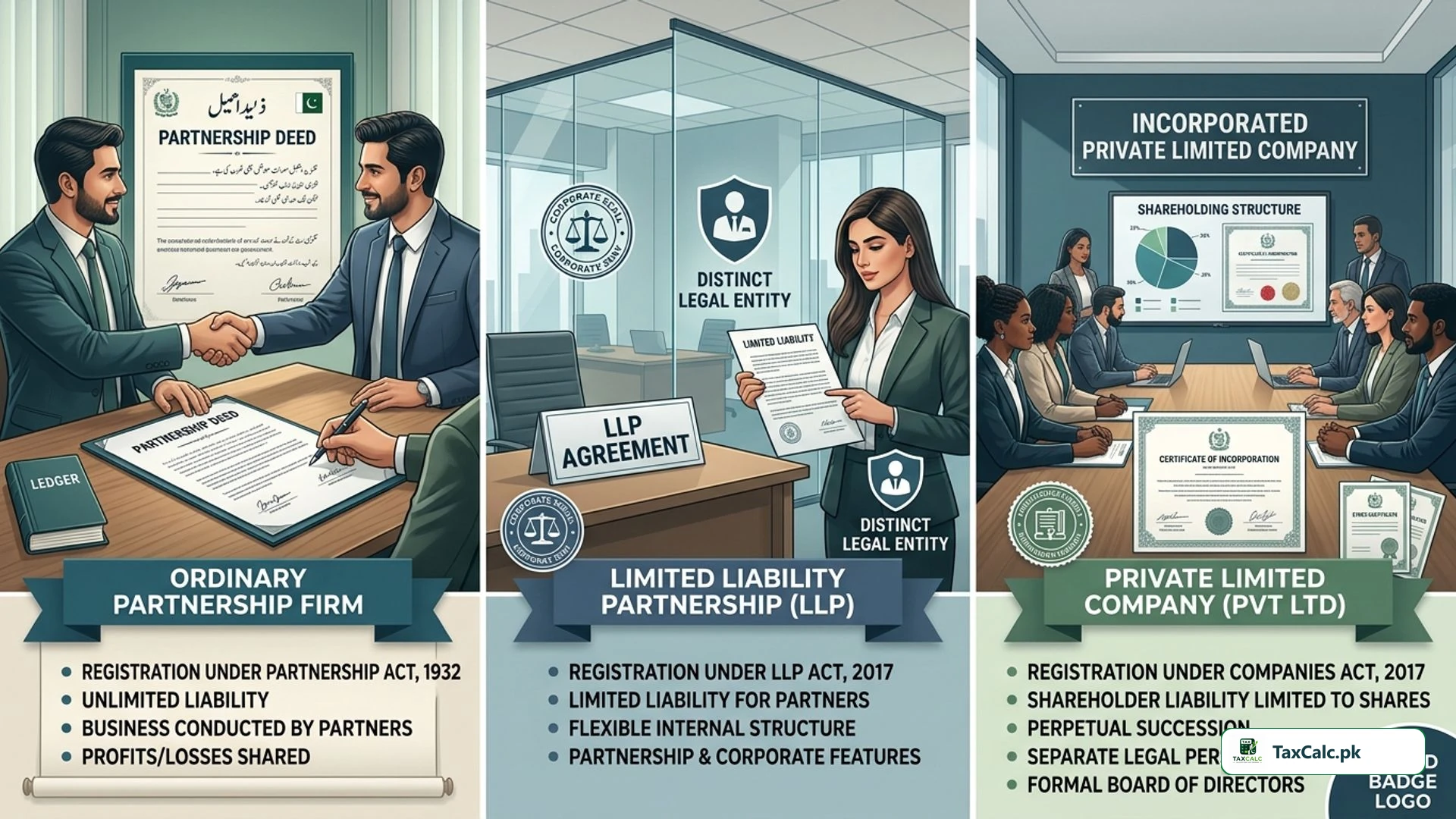
An LLP combines a separate legal identity with a partnership-based ownership arrangement. An ordinary partnership exposes partners to broader personal liability, while a private limited company uses share ownership and formal corporate governance. Your choice should reflect contractual risk, management needs, investment plans and tax treatment.
For business partners in Pakistan, the decision is often presented simplistically as “AOP or company.” That dichotomy leaves out the Limited Liability Partnership (LLP).
An LLP is a distinct legal structure registered with the Securities and Exchange Commission of Pakistan (SECP). Understanding how it bridges the gap between a conventional partnership and an incorporated company can help founders, professional practitioners, and commercial partners make an informed decision before committing to a structure.
An LLP is incorporated under the Limited Liability Partnership Act, 2017. It has a legal personality separate from its partners, enjoys perpetual succession, and continues uninterrupted despite changes in its partnership membership.
It is fundamentally different from an ordinary partnership firm registered under the Partnership Act, 1932 with the local Registrar of Firms:
| Feature / Issue | Ordinary Partnership Firm | Limited Liability Partnership (LLP) | Private Limited Company (Pvt Ltd) | |---|---|---|---| | Governing Statute | Partnership Act, 1932 | Limited Liability Partnership Act, 2017 | Companies Act, 2017 | | Registration Authority | Provincial Registrar of Firms (Industries Dept) | SECP (Securities & Exchange Commission of Pakistan) | SECP (Securities & Exchange Commission of Pakistan) | | Ownership Unit | Partners holding contractual profit shares | Partners holding contractual capital/profit shares | Shareholders holding allotted shares of fixed nominal value | | Constitutional Document | Partnership Deed on stamp paper | Registered LLP Agreement | Memorandum and Articles of Association (MOA & AOA) | | Corporate Legal Entity | No separate legal personality distinct from partners | Yes: Separate juristic person with perpetual succession | Yes: Separate juristic person with perpetual succession | | General Liability Position | Unlimited personal liability: partners are jointly and severally liable for all firm acts | Statutory limited liability: partners are not personally liable for debts of the LLP | Limited liability: shareholder exposure is strictly limited to unpaid share capital | | Internal Governance | Informal or as defined in the deed (mutual agency) | Highly flexible; governed by partners in accordance with LLP Agreement | Formal hierarchy: Shareholders elect a Board of Directors; Chief Executive manages | | Statutory Management | All partners or managing partner | At least two Designated Partners (at least one resident in Pakistan) | At least two Directors (or one for SMC-Pvt Ltd) and a Chief Executive | | Transfer / Equity Expansion | Requires deed revision, dissolution, or reconstitution of the firm | Admission or retirement under LLP Agreement and SECP filing | Straightforward transfer or allotment of shares under company law | | Income Tax Classification | Association of Persons (AOP) | Association of Persons (AOP) under Section 80(2)(a) | Company under Section 80(1)(b) |
[!NOTE]
The liability comparison concerns the owners’ personal legal exposure. It does not mean that an LLP or private limited company can avoid paying its own commercial debts. The assets, accounts, and properties of the entity remain fully answerable to its creditors and court decrees.
For an ordinary partnership, Section 25 of the Partnership Act, 1932 provides that every partner is liable, jointly with all other partners and also severally, for all acts of the firm done while they are a partner.
A partnership deed can internally allocate debts, specify indemnities, or cap liabilities between partners. However, such private agreements do not extinguish a third-party creditor’s statutory right to attach any partner's personal house, car, or bank balance to satisfy a debt of the firm.
For an LLP, Sections 15–17 of the LLP Act, 2017 fundamentally alter this risk:
[!WARNING]
Limited Liability Is Not Immunity From Personal Misconduct:
Under Section 16(2) and Section 17 of the LLP Act, a partner remains personally liable for their own wrongful acts, negligence, or unauthorized commitments. If the business is carried on with intent to defraud creditors or for any fraudulent purpose, the liability of the individuals involved becomes unlimited.
For any structure—whether an LLP, partnership, or company—always review personal guarantees separately. Banks, institutional lenders, and major commercial landlords in Pakistan frequently require owners to sign personal guarantees or deposit title deeds. Ask who is signing, in what legal capacity, and whether the document creates an independent, enforceable personal obligation that pierces the corporate shield.
An LLP agreement is a tailored charter explaining how partners will contribute capital, manage operations, and distribute economic returns.
Before registering an LLP with SECP, partners must document consensus on:
Section 12 of the LLP Act, 2017 provides that the mutual rights and duties of the partners and the LLP are governed by the registered LLP agreement. In the absence of an agreement on any specific matter, the default statutory rules in the First Schedule to the Act apply automatically. Leaving these governance questions unaddressed can create crippling legal uncertainty when partners disagree.
Neither structure guarantees commercial funding or prevents partnership disagreements. The legal form should mirror how you genuinely intend to manage capital and authority.
A frequent misconception among entrepreneurs is assuming that because an LLP is incorporated with SECP, it is automatically taxed as a company.
SECP incorporation does not mean company taxation under Pakistan tax law.
Under Pakistan’s Income Tax Ordinance, 2001 (consolidated through the Finance Act, 2026):
There is also a vital statutory distribution rule that founders and advisors often miss:
Under Section 92(4A) of the Income Tax Ordinance, where an LLP’s income is exempt from tax under any provision of the Ordinance, a partner’s share received from those exempt profits is included in that member’s taxable income and taxed accordingly.
Do not assume that an income-tax exemption available at the LLP level automatically passes through as tax-free income into the personal hands of the partners.
By contrast, for private limited companies, Section 94 establishes separate legal taxation for the company, and distributions to shareholders are taxed as dividends under Section 5 subject to a 15% withholding tax under Section 150.
Before choosing a structure, model both the entity-level tax liability and the net cash in hand after distribution to the owners under the applicable tax year rules.
Maintaining an active business structure requires ongoing administrative discipline. The statutory workload differs across the three models:
Before deciding, obtain a realistic annual compliance cost estimate covering bookkeeping, tax advisory, and regulatory filings. Initial registration fees represent only a small fraction of the lifetime operational cost of maintaining a legal structure.
| Your Primary Business Need | Recommended Structure to Evaluate | |---|---| | A straightforward business operated directly by two or more partners with low contractual liability | Ordinary Partnership Firm, provided personal asset exposure is acceptable to all partners. | | Professional practices (lawyers, accountants, consultants) wanting partner-led management with limited liability | Limited Liability Partnership (LLP) under SECP. | | Capital-intensive businesses, tech startups, or ventures seeking outside investor equity and bank financing | Private Limited Company (Pvt Ltd) under the Companies Act, 2017. | | Single founder starting alone | Evaluate Sole Proprietorship vs Single Member Company (SMC). | | Regulated or licensed sector (banking, insurance, security, medical devices) | Check sector-specific regulator rules; many statutory bodies mandate an incorporated private company. |
For example, two tech or legal consultants might compare an LLP and a private company because they want the security of a separate legal entity and limited liability. Their final choice should turn on whether they want flexible partner distributions (LLP) or a formal equity-shareholding structure designed for third-party venture investors (Private Limited Company).
Before registering, prepare a concise business brief summarizing your expected commercial activities, projected annual turnover, anticipated borrowing, and long-term ownership goals. Consult our dedicated Company & Firm Registration Services for comprehensive legal representation and tailored structuring advisory from experienced High Court advocates.
Legal & Statutory Notice: The information provided in this publication is for general educational, academic, and statutory informational purposes only under the relevant laws of Pakistan (including the Income Tax Ordinance, 2001, the Companies Act, 2017, and the Trade Marks Ordinance, 2001). This content does not constitute formal legal, financial, or tax advice. For specific assessments, consult a licensed Advocate or qualified tax professional.